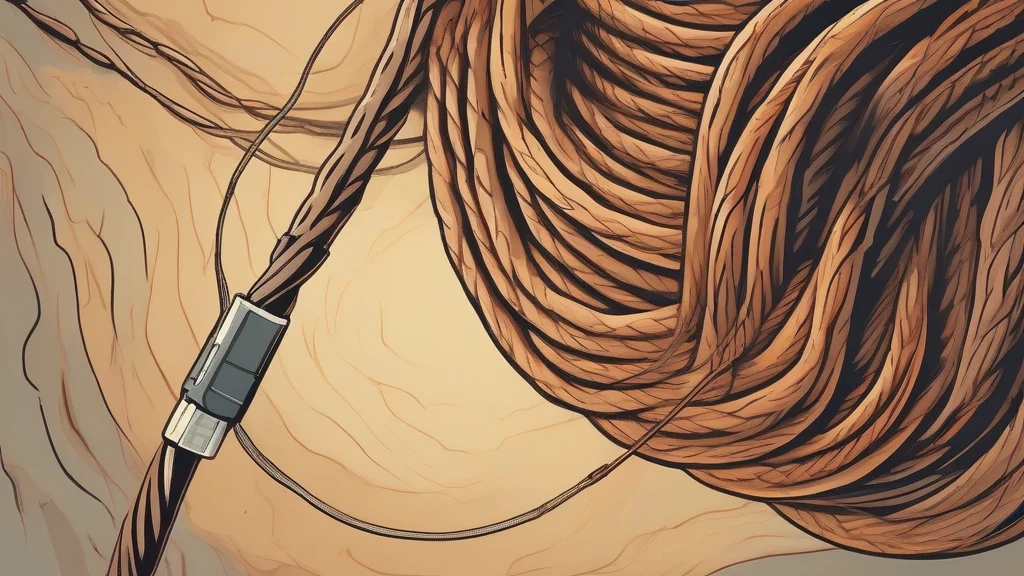
What does cable mean?
A cable is a thick, strong length of twisted metal wires or fibers, built to bear heavy loads, transmit force, or carry electrical and data signals. The word covers everything from the massive steel ropes suspending bridges to the fiber-optic bundles that carry the internet beneath the oceans, as well as household cords connecting appliances and devices. By extension, 'cable' is widely used in everyday speech to mean cable television, a service delivered through such wiring rather than over the air. As a verb, now somewhat dated, it means to send a telegram — historically, transatlantic cables transformed global communication by reducing delivery times from weeks to minutes. Cables connote strength, connection, and infrastructure; the word is neutral and appears equally in engineering manuals, news reports, and casual conversation. It is one of those unglamorous but essential terms underpinning modern life, from elevators to broadband.
A thick, strong rope of twisted hemp, wire, or synthetic fibers used for hauling, mooring ships, or supporting structures such as bridges and cranes; also a bound assembly of insulated electrical conductors or optical fibers used to transmit electricity or signals.
"The suspension bridge is held up by cables anchored deep into the rock on either side of the valley."
In technical contexts, 'cable' specifically denotes multi-conductor assemblies; a single wire is usually just called a wire.
Informal short form for cable television: a system of delivering broadcast programs to subscribers through coaxial or fiber-optic lines.
"They cut the cord and replaced their cable with a streaming service last year."
To send a message by telegraph or submarine cable; formerly a common way of communicating urgent news internationally.
"He cabled his office from New York to confirm the shipment had arrived."
This sense is dated and associated with the telegraph era; it persists mainly in historical contexts.
Standard regular plural; used both for multiple ropes/wires and collectively for cabling systems.
"Thousands of miles of undersea cables carry nearly all international internet traffic."
Before wireless communication, the world's continents were literally stitched together by cables lying on the ocean floor — the first transatlantic telegraph cable in 1858 cut message time from weeks by ship to mere minutes.
Reviewed by Deb Chak, Editor. AI-assisted content curated by RJS Tech Solutions LLP.
Etymology of cable
'Cable' entered English from Old North French 'cable', which derived from medieval Latin 'capulum', meaning a halter or rope, itself formed from Latin 'capere', 'to take or seize'. The word has been part of English since the Middle Ages, originally referring to heavy nautical rope before extending to wire ropes and electrical conductors with industrialization. Cognates include French 'câble' and other Romance descendants of 'capulum'; related English borrowings from the same Latin root 'capere' include 'capstan'.
Related word forms
How cable is actually used
As a noun, 'cable' is standard in both technical and everyday registers. The verb 'to cable' is now largely dated, belonging chiefly to the era of telegraphy, though it survives in historical writing. In casual speech, 'cable' often refers loosely to subscription television ('I cancelled my cable').
Easily confused with cable
Cabbage is an edible leafy vegetable; cable is a rope or bundle of wires — the words merely share similar opening sounds.
A coble is a small flat-bottomed fishing boat used on the north-east coast of England, whereas a cable is a rope or wire conductor.