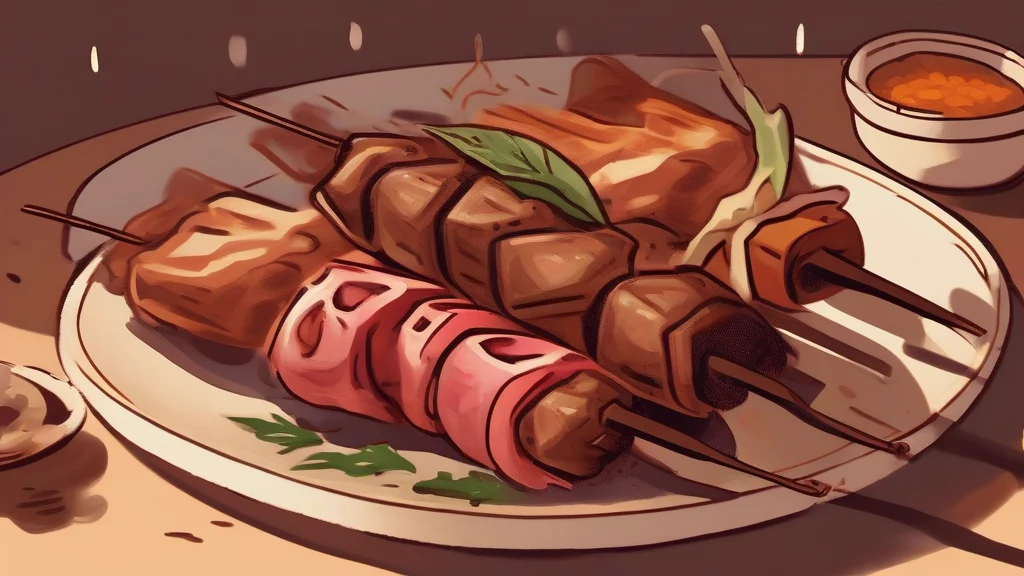
What does cabob mean?
'Cabob' is an archaic English word for what modern speakers call a kebab: small pieces of meat, often marinated, threaded onto a skewer and cooked over fire. The term entered English during the seventeenth and eighteenth centuries through the accounts of travellers to the Ottoman Empire, Persia, and South Asia, who encountered the dish in bazaars and caravanserais and rendered its local name phonetically as 'cabob'. For roughly two centuries it was the standard English spelling, appearing in travelogues, cookery books, and fiction that sought an exotic Eastern flavour. Over the nineteenth century, however, the Turkish-derived spelling 'kebab' gradually displaced it, and by the twentieth century 'cabob' had all but vanished from living use. Today the word survives chiefly in historical documents and antiquarian interest. It is useful to know mainly for readers of early modern travel literature, where its appearance signals the long European fascination with the grilled-meat dishes of the Middle East.
nounAn archaic spelling and pronunciation variant of 'kebab': a dish of small pieces of meat, typically marinated and skewered, then grilled or roasted.
- A dish of marinated pieces of meat threaded on a skewer and grilled or roasted; an early English rendering of what is now usually spelled 'kebab'.
"The travel writer described the street vendors threading cubes of marinated lamb onto skewers to make cabob over open coals."
"In his account of travels through Persia, he praised the succulent cabobs sold in the bazaars of Isfahan."
"The colonial-era cookbook offered instructions for dressing mutton for the grill in the manner of an Eastern cabob."
Regular plural; found almost exclusively in pre-twentieth-century texts.
"The feast featured rice pilafs, stuffed vine leaves, and platters of grilled cabobs."
Before 'kebab' conquered English menus, 17th- and 18th-century travellers to the Middle East wrote home about 'cabobs' — the spelling eventually lost out to the Turkish-derived form we use today.
Reviewed by Deb Chak, Editor. AI-assisted content curated by RJS Tech Solutions LLP.
Etymology of cabob
'Cabob' entered English in the seventeenth century as a phonetic transcription of the Arabic 'kabāb', adopted into Persian, Turkish, and Urdu for spiced roasted meat. Early travellers and merchants wrote the word variously as 'cabob', 'caboob', and 'kebob' before the Turkish-influenced spelling 'kebab' became standard. It is thus a direct doublet of 'kebab' rather than a distinct word, sharing the same Arabic root.
How cabob is actually used
'Cabob' is now obsolete or at best very rare, surviving mainly in historical texts, period fiction, and scholarly discussion of early modern travel writing. Modern writing uses 'kebab' (or regional variants such as 'shish kebab' or 'satay' where appropriate). Using 'cabob' today signals deliberate archaism or quotation from older sources.
Easily confused with cabob
A cobweb is a spider's web; a cabob is grilled meat on a skewer — they differ in both meaning and origin despite superficial visual similarity.