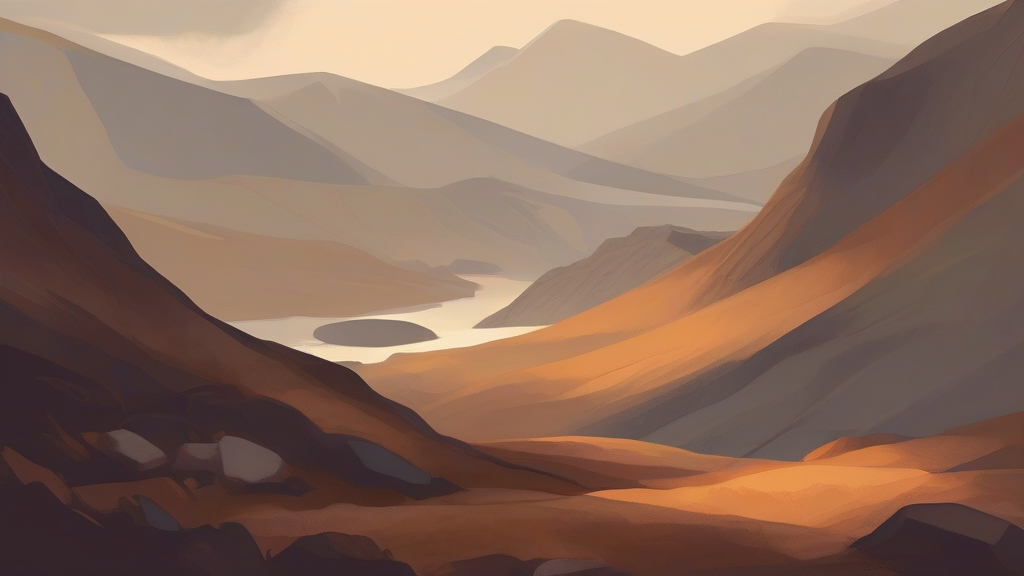
What does cairngorm mean?
A cairngorm is a brownish-yellow to smoky-grey variety of quartz, valued as a gemstone and named after the Cairngorm Mountains of north-eastern Scotland, where such stones were historically found. In mineralogical terms it is a form of smoky quartz whose colour ranges from warm honey tones to deep grey-brown, caused by natural irradiation of the crystal. The word entered English in the late eighteenth century as the name of both the mountain range and its characteristic stone. Cairngorms enjoyed great popularity in Georgian and Victorian Britain, when they were cut and set into brooches, kilt pins, sword hilts, and other pieces of Highland dress jewellery, often in silver mounts. Because genuine Scottish specimens are now rare, most gemstones sold under this name come from Brazil. The word remains current mainly in antiques, jewellery, and mineral-collecting contexts, where it carries connotations of traditional Scottish craftsmanship.
nounA variety of smoky quartz, typically yellow-brown to grey-brown, found chiefly in the Cairngorm Mountains of Scotland and used as a gemstone.
- A brownish-yellow or smoky variety of quartz used as a gemstone, especially one found in the Cairngorm Mountains of Scotland.
"The antique brooch was set with a large cairngorm that glowed amber in the candlelight."
"The antique brooch was set with a large cairngorm that glowed amber in the candlelight."
"Collectors prize genuine cairngorms from the Cairngorm range, though much of the material on today's market comes from Brazil."
The plural refers either to multiple individual gemstones or collectively to stones of this type.
"The collection included several fine cairngorms set in silver."
This gemstone takes its name from a Scottish mountain range whose highest peak literally means 'blue cairn' — and it became the signature jewel of Victorian Scottish jewellery.
Reviewed by Deb Chak, Editor. AI-assisted content curated by RJS Tech Solutions LLP.
Etymology of cairngorm
The word 'cairngorm' derives from the Cairngorm Mountains in Scotland, itself an anglicisation of Scottish Gaelic 'An Càrn Gorm', meaning 'the blue cairn' — from 'càrn' (a heap of stones or rocky hill) and 'gorm' (blue). The gemstone took its name from the mountain range where it was first found, with the term established in English by the late eighteenth century. It shares its Gaelic root 'càrn' with the word 'cairn', the familiar name for a man-made pile of stones.
How cairngorm is actually used
Chiefly British usage, strongly associated with Scottish jewellery of the eighteenth and nineteenth centuries. The term often appears in the fuller phrase 'cairngorm stone'. Much gem material sold as cairngorm today is actually smoky quartz from Brazil rather than true Scottish stones.
Easily confused with cairngorm
Carnelian is a reddish-orange variety of chalcedony, whereas cairngorm is a brownish-yellow variety of smoky quartz.