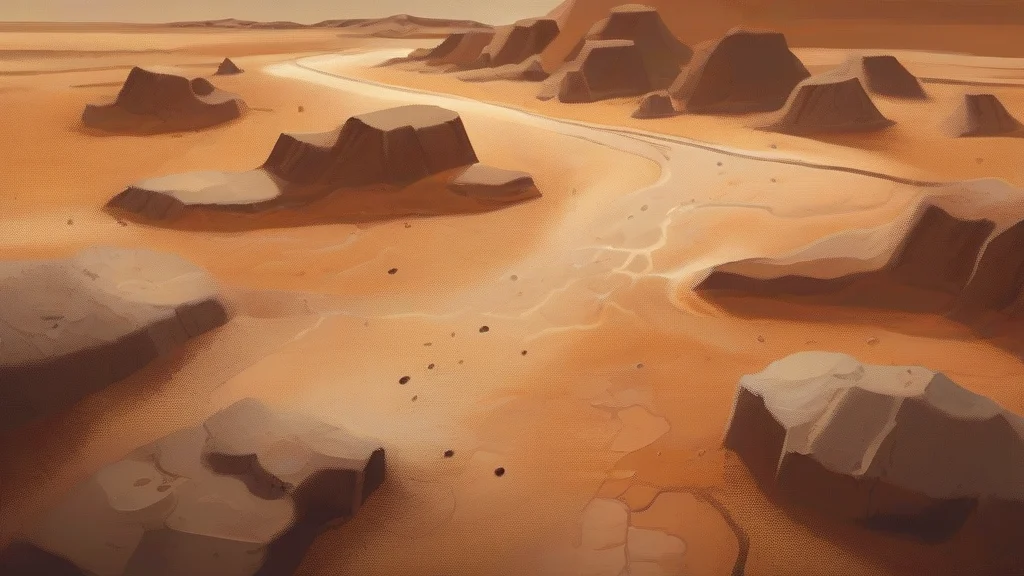
What does caliche mean?
Caliche is a noun naming a hard, mineralized layer of soil that forms near the surface in arid and semi-arid regions. As groundwater carrying dissolved calcium carbonate evaporates upward through the soil, it deposits minerals that gradually cement loose grains of sand and gravel into a dense, rock-like crust — sometimes only inches below the surface. This crust is notorious among farmers, gardeners, and road builders in places like Texas, Arizona, and New Mexico, because it resists digging, blocks root growth, and impedes drainage, often requiring heavy machinery to break through. The same word also refers to the nitrate-rich ore deposits of Chile's Atacama Desert, which supplied most of the world's sodium nitrate fertilizer in the nineteenth century before synthetic production took over. Borrowed from Spanish, caliche remains a specialized but vivid term, instantly recognizable to anyone who has swung a pickaxe at the baked ground of the desert Southwest and heard the dull ring of stone where they expected soil.
nounA hard, cement-like layer of soil formed by calcium carbonate and other minerals that accumulates beneath the surface in arid and semi-arid regions. The term also refers to the nitrate-rich gravelly deposits of Chile from which sodium nitrate was once mined.
- A hard, calcium-carbonate-cemented soil layer found in arid and semi-arid regions, often impeding digging and drainage.
- Nitrate-bearing gravel and rock deposits in Chile, historically mined as a source of sodium nitrate.
"The excavator struck a thick shelf of caliche just below the topsoil, slowing construction to a crawl."
"Before planting the orchard, the farmers had to rip through several feet of caliche to reach workable soil."
"In the late nineteenth century, Chilean caliche was the world's principal source of natural sodium nitrate."
The plural is rare in practice, since the word usually functions as an uncountable mass noun describing a soil type or material.
"The geological survey mapped several distinct caliches across the basin."
In Chilean mining towns, the word caliche once meant fortune itself — the nitrate-rich dirt shipped worldwide as fertilizer before synthetic alternatives collapsed an entire industry.
Reviewed by Deb Chak, Editor. AI-assisted content curated by RJS Tech Solutions LLP.
Etymology of caliche
Caliche entered English from Spanish, where it has long been used in both Spain and Latin America for hardened, lime-rich earth. Its ultimate origin is generally traced to Latin calx, meaning limestone or lime, the same root that gives English words such as calcium, calcite, and chalk. The word became established in English-language usage through contact with Spanish speakers in the American Southwest and through accounts of Chilean nitrate mining, where caliche denoted the saltpeter-bearing ore itself.
How caliche is actually used
The word is chiefly technical and regional, familiar mainly to geologists, agronomists, builders, and residents of the American Southwest, where caliche layers are a common obstacle to excavation and gardening. It carries no emotional connotation but is strongly associated with dry climates.
Easily confused with caliche
Chalk is a soft, porous marine limestone used for writing and drawing, whereas caliche is a hard mineral crust deposited in desert soils.
Hardpan is a general term for any dense, impervious soil layer, while caliche specifically refers to such a layer cemented by calcium carbonate.