What does calla mean?
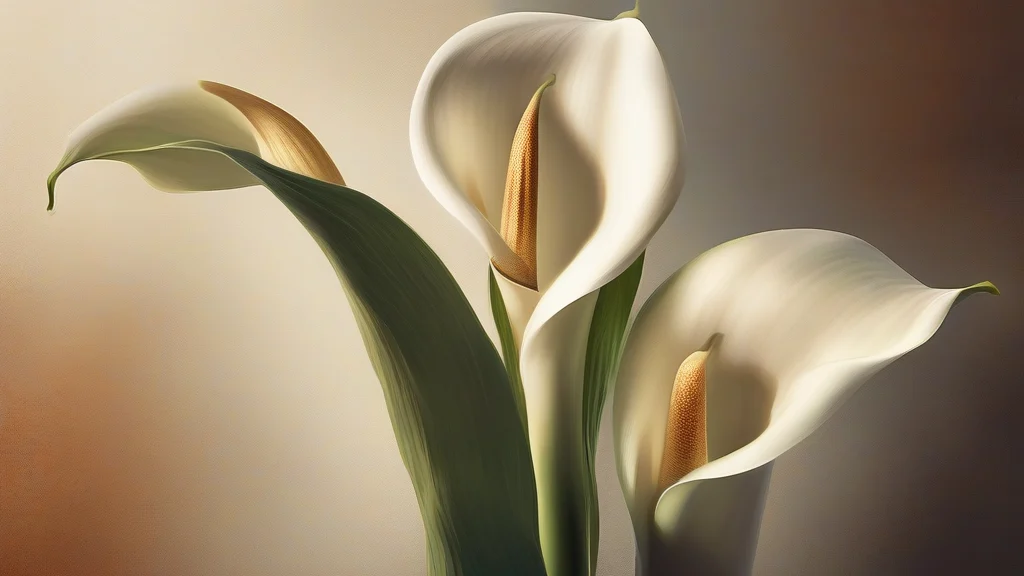
The word calla refers most familiarly to the calla lily, one of the most elegant and widely loved flowers in cultivation. With its smooth, funnel-shaped spathe and central yellow spadix, the calla has become a staple of weddings, funerals, and formal floral design, its clean white form symbolizing purity and refinement. Strictly speaking, however, these popular garden plants belong to the African genus Zantedeschia, while the name Calla in botany originally designated Calla palustris, the bog arum — a humble wildflower of northern marshes. The confusion arose because both are members of the arum family, whose distinctive flower structure unites them. In ordinary usage, then, a calla is understood as the graceful cut flower rather than the bog plant. Whether encountered in a bridal bouquet, a Georgia O'Keeffe painting, or a gardener's catalogue, the word carries connotations of simplicity, elegance, and understated beauty, making it as evocative as the flower itself is striking.
nounA calla is either a plant of the genus Calla, especially the bog arum (Calla palustris) of northern wetlands, or — more commonly in everyday usage — any of several related ornamental plants known as calla lilies (genus Zantedeschia), prized for their elegant, trumpet-shaped white flowers.
- Any of several showy ornamental plants known as calla lilies (genus Zantedeschia), grown for their elegant funnel-shaped flowers, especially popular in weddings and floral arrangements.
- The bog arum (Calla palustris), a small creeping plant of marshes and bogs in cool northern regions, the original botanical bearer of the name Calla.
"The bride carried a simple bouquet of white callas down the aisle."
"The florist arranged tall white callas in a sleek glass vase for the reception."
"In the peat bog we spotted the low-growing bog arum, Calla palustris, with its glossy leaves and scarlet berries."
The regular plural is used when referring to multiple flowers or plants; 'calla' itself is frequently left unchanged when used attributively, as in 'calla lily arrangements.'
"The arrangement featured a dozen white callas tied with silk ribbon."
Despite its name, the beloved 'calla lily' isn't a true lily at all — and it isn't even the plant botanists originally called Calla!
Reviewed by Deb Chak, Editor. AI-assisted content curated by RJS Tech Solutions LLP.
Etymology of calla
The name calla comes from New Latin Calla, the botanical genus name established by Carl Linnaeus in the eighteenth century. Its ultimate origin is generally traced to Greek, possibly connected to kalos, meaning 'beautiful,' the same root that gives us words such as calligraphy ('beautiful writing') and callisthenics ('beauty and strength'). When nineteenth-century botanists recognized that the popular ornamental 'calla lilies' belonged to a separate genus, they were reclassified as Zantedeschia, yet the old name survived in everyday English through the enduring phrase 'calla lily.'
How calla is actually used
In everyday speech and gardening contexts, 'calla' almost always refers to Zantedeschia species, usually via the phrase 'calla lily.' Botanically speaking, however, the name properly belongs to Calla palustris, and the two are distinct genera — a point that can trip up even keen gardeners. The plural 'callas' is standard when referring to the flowers themselves.
Easily confused with calla
A callus is an area of thickened, hardened skin (or plant tissue over a wound), whereas calla is a flowering plant — the two share visual similarity in spelling but have entirely unrelated meanings.