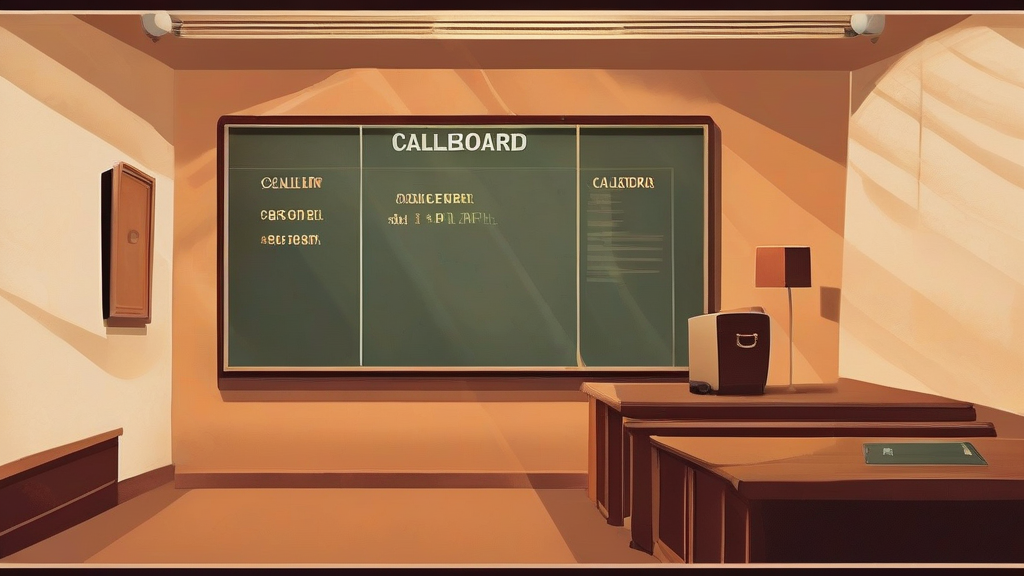
What does callboard mean?
A callboard is a dedicated notice board found backstage in theatres and on film sets, where essential information about productions is posted for the company to read. Its contents typically include rehearsal and performance calls—the scheduled times at which performers must report—along with casting lists, schedule revisions, blocking notes, and general announcements from the stage manager or production office. The word combines "call," in the theatrical sense of an assigned reporting time, with "board," reflecting the physical surface on which these notices appear. Because timely communication is critical to live performance, checking the callboard has long been treated as a basic professional responsibility for actors and crew alike. While the term remains current in theatre circles, digital scheduling tools have supplemented, though not entirely replaced, the traditional board. For outsiders, "callboard" may simply sound like a synonym for a bulletin board, which is essentially what it is—but one bound to the specific rituals and routines of stagecraft.
nounA bulletin board, typically located backstage in a theatre or on a film set, on which notices concerning rehearsals, performances, casting, schedules, and other company business are posted.
- A board in a theatre or film-production space on which notices of rehearsals, calls, casting, schedules, and other company information are posted.
- By extension, any workplace bulletin board used for staff announcements.
"The stage manager pinned the revised rehearsal schedule to the callboard before the actors arrived."
"Actors were expected to check the callboard each morning for any last-minute changes to the day's schedule."
"A memo announcing the new lighting designer was tacked up on the studio's callboard."
Standard plural; used when referring to more than one board, such as across venues or production offices.
"Both theatres maintained their own callboards near the stage door."
Long before group chats and email blasts, every piece of news that mattered backstage—from casting changes to curtain times—traveled through one humble object: the callboard.
Reviewed by Deb Chak, Editor. AI-assisted content curated by RJS Tech Solutions LLP.
Etymology of callboard
The word "callboard" is a straightforward English compound formed from "call" and "board." In theatrical usage, a "call" is an appointed time at which a performer or crew member must be present, a sense established in stage practice well before the twentieth century; the callboard was thus literally the board bearing those calls. The element "board" descends from Old English "bord" meaning plank or flat surface, making the compound cognate with formations such as "blackboard," "billboard," and "keyboard." The term arose organically within Anglophone theatre and film production rather than being borrowed from another language, and it spread with standard backstage practice across British and American companies.
How callboard is actually used
"Callboard" is a term of art within theatre and film production; it is understood by industry professionals but may be unfamiliar to the general public, who would more likely say "bulletin board." It is neutral in register and carries no strong connotation beyond its professional association with backstage life.
Easily confused with callboard
A call sheet is a printed or digital daily schedule distributed to cast and crew, whereas a callboard is the physical board on which such notices are displayed.
A blackboard is a dark surface written on with chalk for instruction, while a callboard is a surface for pinning or posting theatrical notices.