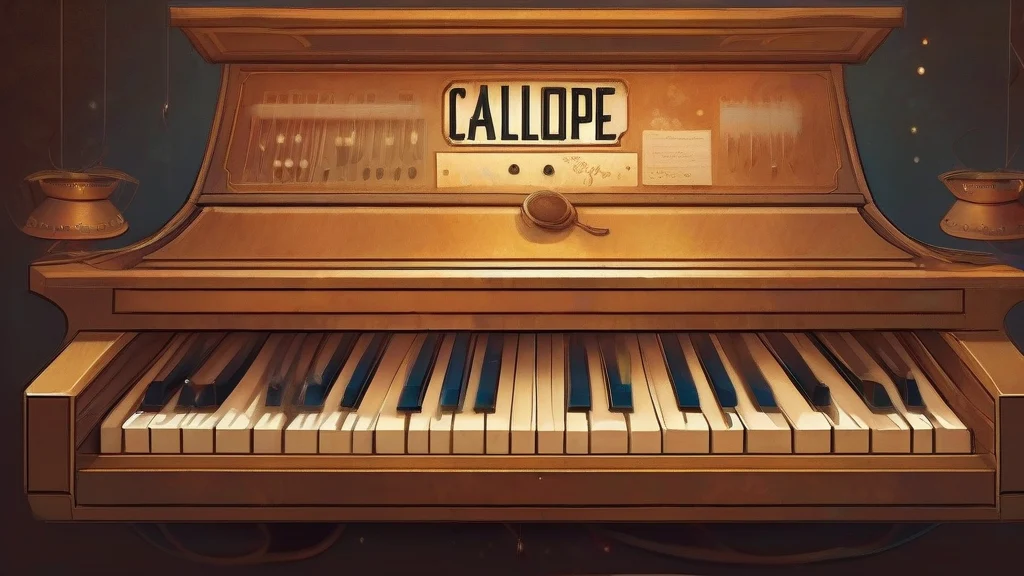
What does calliope mean?
A calliope is a musical instrument that generates sound by passing steam or compressed air through an array of large, powerful whistles, operated via a keyboard much like an organ. Developed in the United States during the nineteenth century, it became famous for its deafening volume and its association with Mississippi riverboats and traveling circuses, where its far-carrying notes served as audible advertising for miles around. Because of its raucous, penetrating tone, the word has also come to suggest any loud, brash music. Separately, Calliope is the name of the eldest of the nine Greek Muses, presiding over eloquence and epic poetry; she was traditionally regarded as the inspiration for Homer's epics. The word derives from the Greek meaning 'beautiful-voiced,' which aptly describes both figures despite the instrument's notoriously unmusical blast. Today the term survives chiefly in historical, nautical, and circus contexts.
A keyboard instrument producing sound by forcing steam or compressed air through large whistles; historically used on showboats and at circuses.
"The paddle steamer's calliope bellowed out popular tunes as it docked."
Sometimes called a 'steam organ' or 'steam piano'.
Calliope, in Greek mythology, the chief of the nine Muses, patroness of eloquence and epic poetry.
"Ancient poets invoked Calliope at the opening of their epic verses."
Typically capitalized when referring to the Muse.
Standard plural; used for multiple instruments.
"Both steamboats moored at the levee had calliopes playing on their upper decks."
A calliope is so loud it was once banned from playing within city limits of some towns — you could hear it ten miles away.
Reviewed by Deb Chak, Editor. AI-assisted content curated by RJS Tech Solutions LLP.
Etymology of calliope
The word 'calliope' comes from Greek Kalliópē, literally 'beautiful voice,' formed from 'kalos' (beautiful) and 'ops' (voice), the name of the Muse who inspired epic poets. The name was applied to the steam whistle instrument invented in the mid-nineteenth century, presumably ironically or aspirationally given its harsh tone. The same Greek root 'kalos' gives us related English borrowings such as 'calligraphy' (beautiful writing) and 'kaleidoscope' (beautiful form).
How calliope is actually used
The plural 'calliopes' refers both to multiple instruments and, in American English colloquial usage, to small whistles on locomotives. When capitalized, 'Calliope' refers specifically to the Greek Muse.
Easily confused with calliope
Clio is the Muse of history, whereas Calliope is the Muse of epic poetry and eloquence.