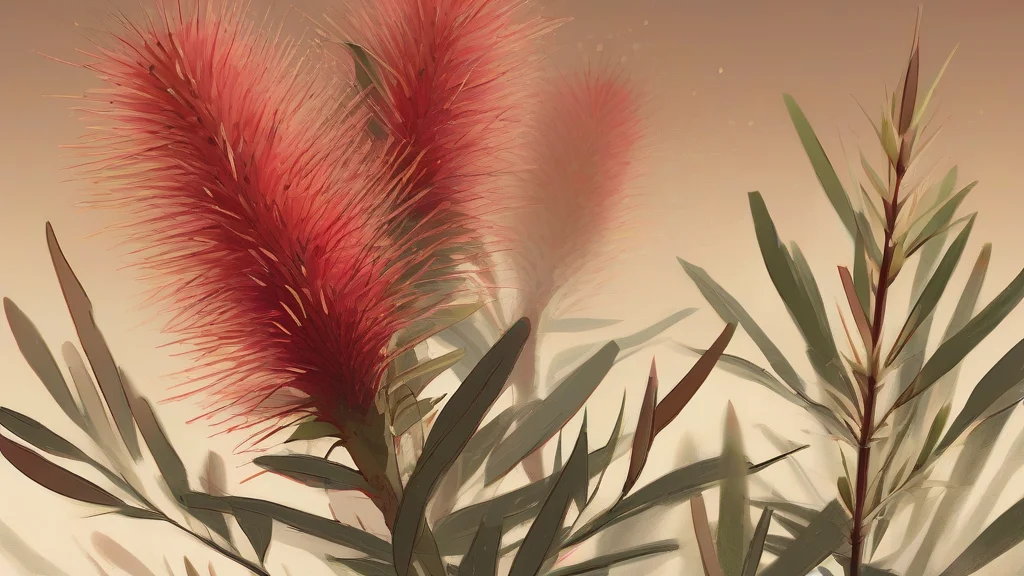
What does callistemon mean?
Callistemon is a noun referring to a genus of evergreen shrubs and small trees native to Australia, belonging to the myrtle family. The name derives from Greek roots meaning 'beautiful stamen', a fitting tribute to the plant's defining feature: dense, cylindrical flower spikes in which long, brightly coloured stamens project outward like the bristles of a bottle brush, giving rise to its popular common name, bottlebrush. Typically flowering in shades of vivid red, crimson, pink, or yellow, callistemons are a magnet for nectar-feeding birds such as honeyeaters, which makes them prized in wildlife-friendly gardens. Widely cultivated far beyond their native range — including in Britain, the Mediterranean, and the southern United States — they favour sunny positions and well-drained soil. In everyday speech gardeners usually say 'bottlebrush', reserving 'callistemon' for formal horticultural writing, nursery labels, and botanical discussion. For anyone interested in Australian flora or bird-attracting planting, the word is both practical and evocative.
nounA genus of Australian evergreen shrubs and small trees of the myrtle family, commonly called bottlebrushes for their cylindrical flower spikes with prominent stamens resembling a bottle brush.
- A genus of Australian evergreen shrubs or small trees (family Myrtaceae) bearing cylindrical flower spikes of long stamens, known as bottlebrushes.
"The garden's most striking feature was a towering callistemon in full red bloom beside the veranda."
"Honeyeaters were drawn all summer to the callistemon along the fence line."
"She planted a dwarf callistemon in the border, where its scarlet brushes bloomed twice a year."
The plural is used when referring to multiple individual plants; the singular often denotes the genus as a whole.
"Several callistemons lined the driveway, each one humming with feeding lorikeets."
Named from Greek words meaning 'beautiful stamen', the callistemon is the plant behind Australia's beloved bottlebrush flowers — so showy that gardeners worldwide grow it just to watch birds flock to its crimson spikes.
Reviewed by Deb Chak, Editor. AI-assisted content curated by RJS Tech Solutions LLP.
Etymology of callistemon
The word callistemon comes directly from New Latin, coined as a scientific genus name from two ancient Greek elements: kallistos ('most beautiful') and stēmōn ('thread' or 'stamen'), chosen because of the plant's conspicuously ornamental flower stamens. It entered English usage through nineteenth-century botanical literature describing the Australian flora being catalogued by European naturalists. Its Greek components connect it to a wider family of learned coinages, sharing the root kallis with words like calligraphy and kaleidoscope, and linking stēmōn to the familiar botanical term stamen itself.
How callistemon is actually used
Used almost exclusively in horticultural and botanical contexts; in everyday gardening talk people more often say 'bottlebrush'. The plural 'callistemons' is standard when referring to individual plants.
Easily confused with callistemon
Melaleuca is a closely related genus of paperbarks that also has brush-like flowers, but Callistemon species are distinguished by their free stamens rather than fused bundles.
Chrysanthemum shares the '-anthemum'-style botanical naming flavor and a similar ending sound, but it is an entirely different flowering plant in the daisy family.