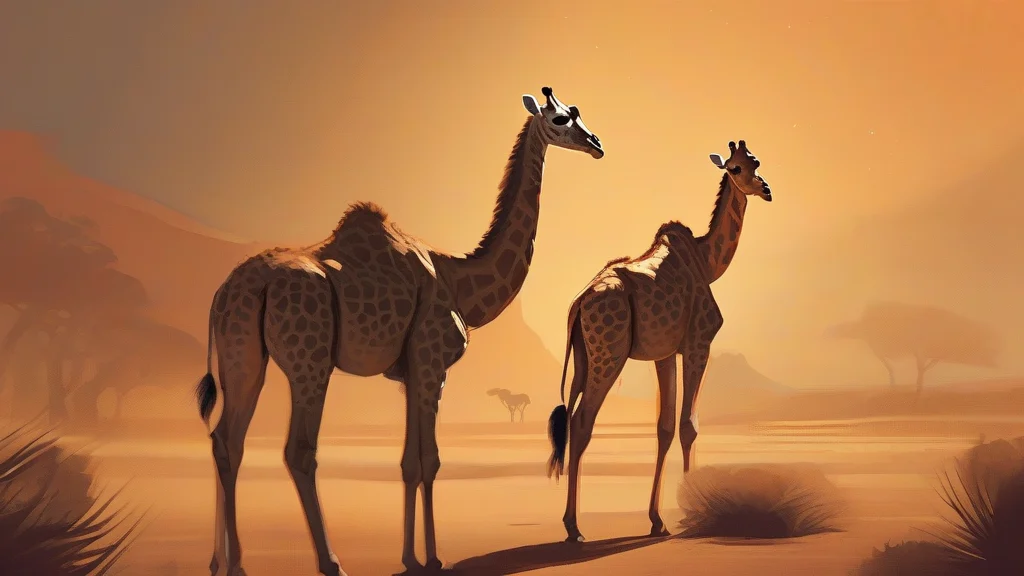
What does camelopard mean?
A camelopard is an archaic English word for the giraffe, the tall, long-necked ruminant native to Africa. The term blends "camel" and "leopard," reflecting early observers' impression that the animal combined the camel's build and bearing with the leopard's spotted coat. It entered European languages through Latin and medieval usage and remained the standard English name for centuries before "giraffe" — borrowed via French from Arabic — displaced it. Today "camelopard" survives mainly in historical texts, heraldic descriptions, and scholarly references, including the giraffe's scientific name, Giraffa camelopardalis. Because it is obsolete in everyday speech, encountering it signals older writing or deliberately elevated diction. The word offers a vivid glimpse into how early naturalists classified unfamiliar animals by analogy with familiar ones, and it remains a charming example of descriptive naming in the history of the English lexicon.
nounAn archaic name for the giraffe, the long-necked African ruminant; the word combines 'camel' and 'leopard', reflecting the animal's camel-like build and leopard-like spotted coat.
- The giraffe (Giraffa camelopardalis), especially in historical, literary, or heraldic contexts.
"The medieval bestiary described the camelopard as a creature with the neck of a camel and the markings of a leopard."
"Ambassadors from Egypt presented the king with a camelopard, an animal few Europeans had ever seen."
"In old heraldic drawings, the camelopard stands beside lions and unicorns as one of the exotic beasts of legend."
Regular English plural; rare, since the singular itself is archaic.
"Ancient Roman spectacles once featured camelopards paraded through the arena."
Before English speakers settled on 'giraffe', they called the animal a camelopard — literally a cross between a camel and a leopard, which is exactly what it was thought to resemble.
Reviewed by Deb Chak, Editor. AI-assisted content curated by RJS Tech Solutions LLP.
Etymology of camelopard
The word derives ultimately from Greek kamēlopardalis, a compound of kamēlos ('camel') and pardos ('leopard'), which passed into Latin as camelopardalus and then through Old French into Middle English. It was the standard English term for the giraffe for several centuries, until "giraffe" — borrowed from Arabic zarāfah via Italian and French — became established by the nineteenth century. Its compound elements survive independently in "camel" and "leopard" (the latter also from Greek pardos, the root of "panther").
How camelopard is actually used
"Camelopard" is archaic and now appears almost exclusively in historical writing, heraldry, and discussions of the giraffe's scientific name (Giraffa camelopardalis). In ordinary modern usage, "giraffe" has entirely replaced it.
Easily confused with camelopard
A leopard is a spotted big cat, while a camelopard is an archaic term for the giraffe — the two words share the '-opard' element but denote entirely different animals.