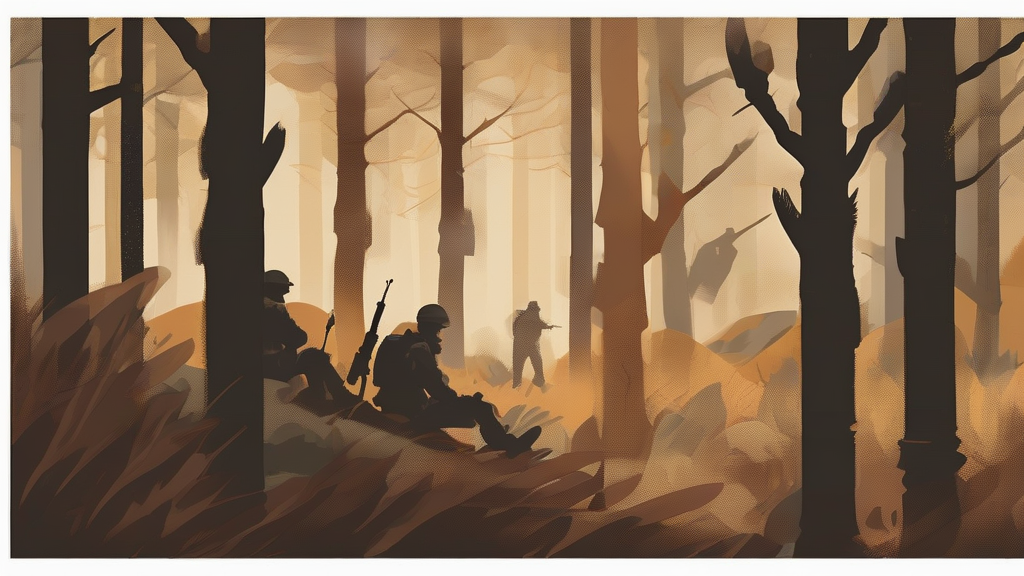
What does camo mean?
Camo is an informal English shortening of 'camouflage,' used chiefly as a noun to describe both the mottled green-and-brown patterning developed for military concealment and the clothing made from it. Originally soldiers' slang — the full term felt cumbersome in everyday speech — the clipped form spread into hunting, outdoor recreation, and eventually mainstream fashion, where camo prints appear on everything from jackets to sneakers. In conversation, people typically say someone is 'wearing camo' rather than 'wearing camouflage,' making it the natural register for speech and casual writing, while formal prose still favors the longer word. Though strongly associated with armies and hunters, the word today carries a dual identity: practical concealment gear on one hand, and a recognizable streetwear aesthetic on the other. Its brevity and vivid visual associations have made it a firmly established part of modern vocabulary.
nounCamo is an informal shortening of 'camouflage,' referring to mottled green, brown, and tan patterns on clothing or equipment designed to make the wearer blend into natural surroundings.
- The mottled green-and-brown pattern used on military clothing and equipment to blend into natural surroundings.
- (Informal) Clothing or gear printed with such a pattern, worn by hunters, outdoorspeople, and as fashion.
"He swapped his bright running jacket for a pair of camo trousers before heading out to the blind at dawn."
"The recruits were issued camo uniforms during basic training."
"She paired a camo jacket with jeans for a casual weekend look."
The plural 'camos' is rare in practice because camo usually functions as an uncountable mass noun ('some camo', 'a pair of camo pants'). When counted, 'camos' appears mostly informally.
"The store stocks several different camos, from woodland to desert patterns."
'Camo' started life as military slang — soldiers were so tired of saying 'camouflage' that they clipped it down to two syllables, and civilians loved it enough to make it a fashion staple.
Reviewed by Deb Chak, Editor. AI-assisted content curated by RJS Tech Solutions LLP.
Etymology of camo
Camo arose in the twentieth century as a colloquial clipping of 'camouflage,' a French word adopted into English during the First World War era. 'Camouflage' itself traces back to the verb 'camoufler' (to disguise), which entered French from Italian 'camuffare' (to disguise or deceive). The shortened form 'camo' reflects a common pattern of military slang, where long borrowed terms are trimmed for quick spoken use, and it has since become fully standard in informal registers on both sides of the Atlantic.
How camo is actually used
Camo is informal and conversational; 'camouflage' is preferred in formal writing. The clipped form is especially common when referring to the physical garments or gear rather than the abstract technique of concealment. In fashion contexts, camo has largely shed its military connotations and is treated as a print or aesthetic.
Easily confused with camo
Though they can sound alike in casual speech, 'camo' means camouflage patterning while 'karma' refers to the spiritual principle of cause and effect.