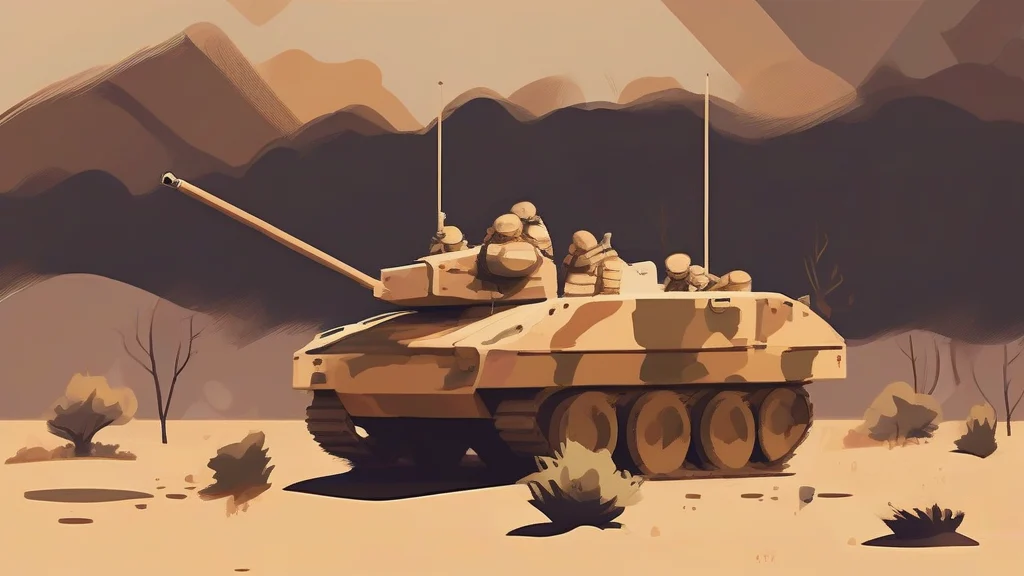
What does camoufleur mean?
A camoufleur is a person who designs and applies camouflage, most commonly an artist recruited by armed forces to disguise troops, vehicles, ships, and installations from enemy observation. The word entered English during the First World War, when both Allied and Central Powers discovered that painters, sculptors, and theatre designers could achieve deceptions that conventional soldiers could not. A camoufleur's work ranged from painting disruptive patterns on artillery and devising dazzle schemes for ships to constructing fake trees, dummy tanks, and concealed observation posts. The term carries a distinctly historical and specialist flavour; it appears mainly in military history, art history, and accounts of wartime deception rather than everyday conversation. Its enduring appeal lies in the striking image it evokes: the artist conscripted not to depict the world but to hide parts of it, turning creative skill into a genuine instrument of war.
nounA person who designs or applies camouflage, especially an artist employed to disguise military equipment and installations.
- A person who designs or executes camouflage, particularly for military purposes.
"During the First World War, the British Army recruited a camoufleur to paint observation posts so convincingly that enemy gunners fired at empty ground."
"The young painter signed up as a camoufleur, trading her studio for the task of making tanks vanish into the landscape."
"As the unit's chief camoufleur, he devised netting and painted patterns that hid the airfield from reconnaissance aircraft."
The standard English plural adds -s; the word takes no other inflected forms.
"The exhibition honoured the camoufleurs whose painted deceptions saved countless convoys."
Some of the First World War's most effective weapons weren't guns at all — they were paintbrushes, held by artists officially titled 'camoufleurs'.
Reviewed by Deb Chak, Editor. AI-assisted content curated by RJS Tech Solutions LLP.
Etymology of camoufleur
Camoufleur derives from the French verb camoufler ('to disguise'), itself probably adapted from the dialectal French camouflet ('a blast of smoke in the face') or ultimately from Italian camuffare ('to disguise'). The noun was adopted into English during the First World War alongside the related borrowing camouflage, which entered English at roughly the same time from French military usage. It thus belongs to the same family of words as camouflage and its derived forms, all tracing back through French to that Italian root of uncertain deeper origin.
How camoufleur is actually used
The term is chiefly historical and military in register, strongly associated with the two World Wars, though it survives among historians of art and warfare and in discussions of camouflage design. The anglicized plural is usually 'camoufleurs'; the French-style 'camoufleurs' with final-sounding vowel is avoided in English.
Easily confused with camoufleur
Camouflage is the concealment itself — the disguise or its techniques — while a camoufleur is the person who creates it.