What does cancellous mean?
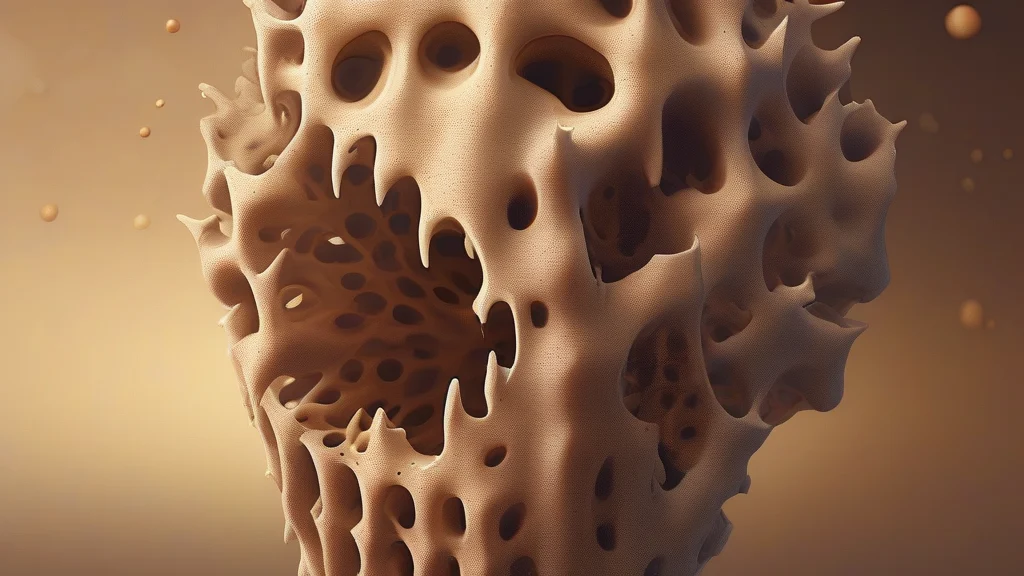
Cancellous is a technical adjective describing something full of small interconnecting cavities, giving it a spongy, latticelike texture. Its dominant use by far is in anatomy and medicine, where 'cancellous bone' names the honeycombed interior tissue found beneath the hard outer shell of bones — especially at the ends of long bones and inside vertebrae, the pelvis, and other flat bones. This trabecular network houses red marrow and gives bone strength while keeping it light, much like the internal struts of engineered structures. Surgeons frequently speak of cancellous bone grafts, since its rich blood supply helps transplanted fragments heal quickly. The word derives from Latin cancelli, meaning grating or lattice — the same root behind 'cancel'. Outside medical writing, cancellous appears only occasionally in descriptions of porous materials such as coral or fossilized tissue. For everyday readers, 'spongy bone' conveys the same idea in plainer language.
(Of bone) having an open, spongy, latticelike internal structure rather than being solid and compact.
"Osteoporosis thins the trabeculae of cancellous bone, leaving it fragile."
Almost always encountered in anatomical and surgical contexts; 'spongy bone' or 'trabecular bone' are common equivalents.
(More generally, rare) having a porous texture pierced with cavities, like a sieve or grating.
"The specimen had a cancellous appearance under the microscope."
This broader use is uncommon today; most writers reserve the word for bone.
Your bones are hollow-ish on purpose: that airy, honeycombed 'cancellous' core makes them strong yet light — the same engineering trick as inside the Eiffel Tower's ironwork.
Reviewed by Deb Chak, Editor. AI-assisted content curated by RJS Tech Solutions LLP.
Etymology of cancellous
Cancellous comes from Latin cancelli, meaning 'bars, grating, or lattice', via the Medieval Latin adjective cancellosus ('full of lattice-work'), entering English in the early modern period. The same root produced the verb 'cancel' — originally to mark a document with crossed lattice lines — as well as 'chancel', the lattice-enclosed area around a church altar, and 'chancellor', a keeper of such a barriered space. Its anatomical sense, describing spongy bone, was established as scientific Latin terminology and remains standard in modern medical usage.
How cancellous is actually used
A technical term used almost exclusively in anatomy, orthopaedics, and histology; rare outside medical contexts, where 'spongy bone' is the more familiar equivalent. Pronunciation stress is commonly on the first syllable, though some dictionaries place it on the second (/kænˈsɛləs/) — both are accepted.
Easily confused with cancellous
Cancellate is a general term for any latticelike or perforated surface (as in shells), while cancellous specifically denotes spongy bone tissue in anatomy.
Chancellor shares the same Latin root cancelli (screen/lattice) but refers to an official or title-holder, not a physical structure.