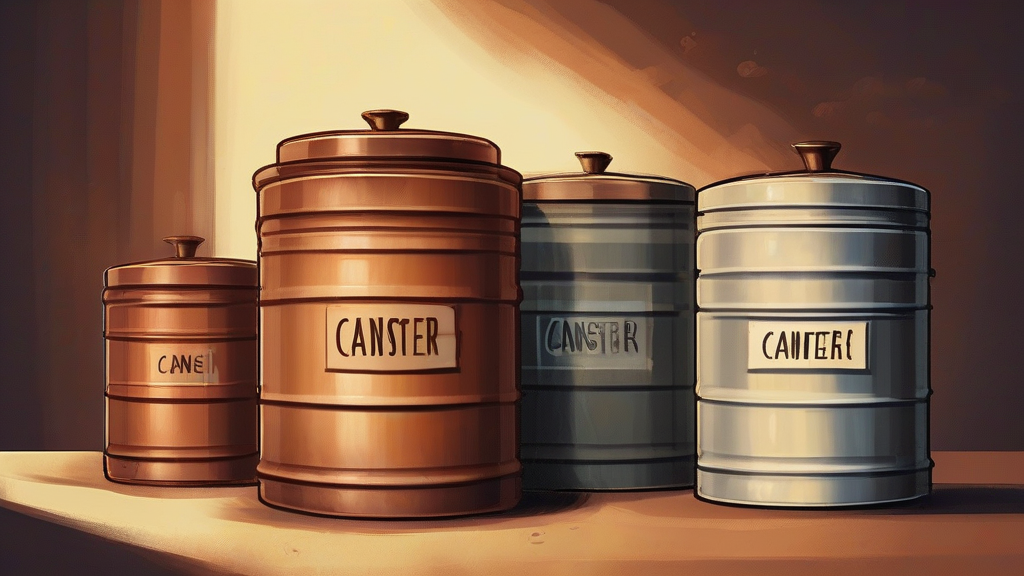
What does canister mean?
A canister is a cylindrical container, typically fitted with a tight-fitting lid, used to store and protect contents such as tea, coffee, flour, photographic film, or pressurized gas. The word carries no particular emotional connotation; it is a plain, functional term found equally in domestic conversation ('the tea canister on the shelf') and in technical or industrial settings ('a propane canister for the stove'). Its most familiar modern uses involve kitchen storage jars and sealed metal cylinders for gases, fuels, or chemicals, though historically it also named a type of artillery ammunition — canister shot — consisting of a case packed with small iron balls. Derived through Latin from a Greek word for a woven reed basket, 'canister' has traveled a long way from its basket-making origins to describe some of the most precisely manufactured containers of the modern world. It is a useful, unambiguous everyday word whose meaning any reader can picture instantly.
A cylindrical container with a lid, used for storing food, film, gas, or other materials.
"Grandmother's kitchen was lined with ceramic canisters full of sugar and spices."
Often used attributively to indicate contents, as in 'tea canister' or 'gas canister'.
In artillery, a case packed with musket balls or scrap metal fired as a single projectile, known as canister shot.
"The battery fired canister into the advancing infantry at close range."
Regular English plural; identical stress and pronunciation pattern in both British and American English.
"The shop sells matching canisters in sets of three."
The word 'canister' began life as the name of a woven reed basket in ancient Rome — and its cousins include the word 'cane'.
Reviewed by Deb Chak, Editor. AI-assisted content curated by RJS Tech Solutions LLP.
Etymology of canister
'Canister' entered English in the early 17th century, borrowed from Latin 'canistrum', meaning a woven basket, which itself derives from Greek 'kanastron', a reed basket. The underlying root is the Greek 'kanna', meaning reed, the same source that gives English 'cane' and, more distantly, 'channel' and 'canyon'. Over time the word shifted from describing wickerwork baskets to denoting rigid, often metal containers.
How canister is actually used
Neutral register, common in everyday household and technical contexts. In British English, 'canister' often specifically suggests a container for tea or dry provisions, while American usage more freely covers pressurized gas cylinders. The plural 'canisters' follows regular English pluralization.
Easily confused with canister
A canker is an ulcerous sore or plant disease, whereas a canister is simply a container; they differ by only a few letters but share nothing in meaning.