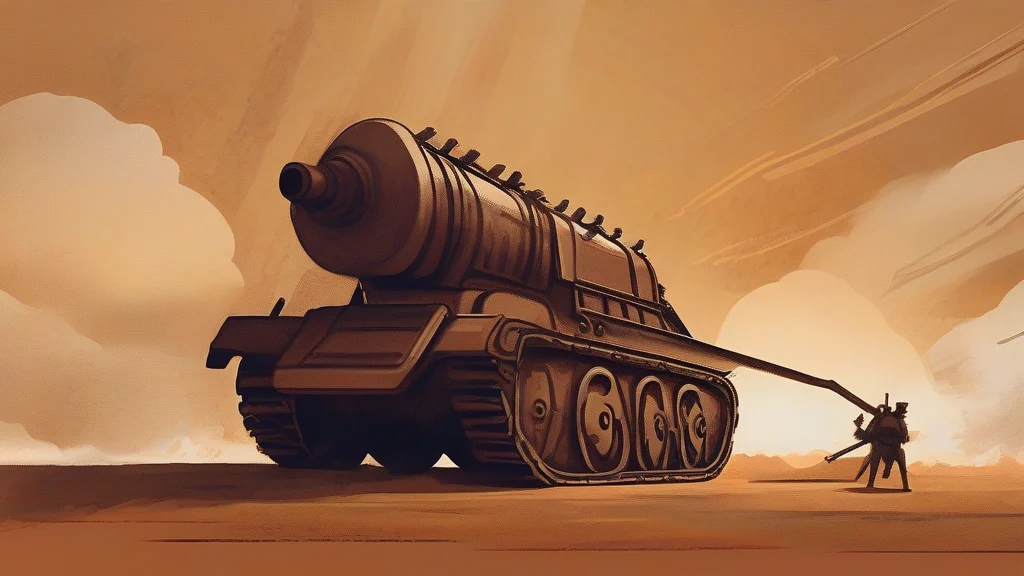
What does cannonaded mean?
Cannonaded is the past tense of cannonade, a verb meaning to bombard a target continuously and heavily with cannon fire. The term evokes the age of black-powder warfare, when sieges could hinge on hours of unrelenting artillery barrage, and it remains most at home in historical and military writing. By extension, English speakers use it figuratively: a politician may be cannonaded with hostile questions, or a writer cannonaded by critics, meaning they faced a sustained, overwhelming verbal assault rather than actual shells. The word carries connotations of intensity, relentlessness, and force on a grand scale — a single shot is not a cannonade, just as a lone remark is not being cannonaded with questions. Derived from the Italian cannone ('large tube'), via Latin canna ('reed' or 'tube'), it shares deep roots with everyday words like cane and canal. For anyone writing about history, conflict, or heated public debate, cannonaded offers a vivid way to convey sustained, concentrated attack.
verbPast tense and past participle of "cannonade": subjected to a continuous, heavy bombardment of cannon fire; figuratively, attacked relentlessly with words or criticism.
- To subject a place or position to sustained heavy gunfire from cannons (literal military use)
- To attack someone persistently with words, questions, or criticism (figurative use)
"The fortress walls were cannonaded for three days before they finally crumbled."
"Enemy batteries cannonaded the harbor fortifications throughout the night."
"Reporters cannonaded the minister with questions as she left the briefing room."
The word for relentless bombardment comes from an Italian word that literally means 'big tube' — a cannon is just a large version of the Latin word for a hollow reed.
Reviewed by Deb Chak, Editor. AI-assisted content curated by RJS Tech Solutions LLP.
Etymology of cannonaded
Cannonade derives from the Italian cannone, an augmentative of canna meaning 'large tube' or 'cannon', which itself traces back to the Latin canna, a reed — the same root that gives English cane, canal, and canyon (via Spanish cañón). The verb entered English in the 16th or early 17th century, during the period when gunpowder artillery reshaped European warfare, and its past tense cannonaded naturally followed. Its figurative extension to relentless verbal attack developed later, applying the imagery of sustained bombardment to speech and criticism.
Related word forms
How cannonaded is actually used
The literal sense belongs chiefly to historical or military writing about the era of muzzle-loading artillery; in modern prose it survives mostly in its figurative sense of intense verbal attack. The verb is transitive and typically appears in passive constructions.
Easily confused with cannonaded
"Canonized" means declared a saint or elevated to canonical status, while "cannonaded" means bombarded with cannon fire.