What does canyon mean?
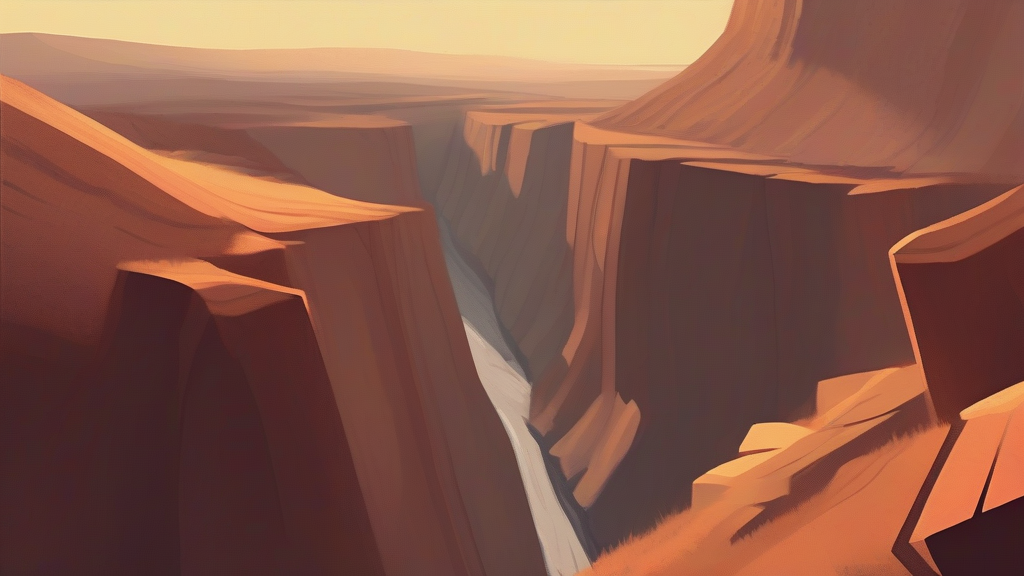
A canyon is a deep, narrow valley bounded by steep cliffs, most often formed over millions of years as a river cuts down through layers of rock. The word entered English from Spanish cañón during the era of westward exploration in North America, which is why it remains strongly associated with landscapes like the Grand Canyon, though comparable landforms occur across the world and are sometimes called gorges or ravines instead. In modern usage, canyon carries connotations of scale, grandeur, and natural drama, making it a staple of travel writing, geography, and photography. It also has a productive figurative life: journalists describe avenues lined with skyscrapers as "urban canyons," borrowing the image of towering walls closing in overhead. Whether literal or metaphorical, canyon reliably evokes depth, enclosure, and awe-inspiring verticality.
A deep, narrow valley with steep sides, typically formed by erosion from a river.
"The trail follows the canyon floor before climbing to a scenic overlook."
Most common in reference to the arid landscapes of the American West; elsewhere, gorge or ravine may be used interchangeably.
A figurative deep gap or corridor between tall structures, especially skyscrapers lining a city street.
"From above, Manhattan's avenues look like a network of glittering canyons."
Regular pluralization; standard in all registers.
"Utah's national parks are famous for their winding sandstone canyons."
The word "canyon" is essentially Spanish for a big tube — it comes from cañón, an augmentative of caña, meaning "cane" or "pipe."
Reviewed by Deb Chak, Editor. AI-assisted content curated by RJS Tech Solutions LLP.
Etymology of canyon
Canyon derives from the Spanish cañón, an augmentative form of caña, meaning "reed," "cane," or "tube," which traces back through Latin canna to a likely Greek origin (kanna). The sense evolved from something tubular to something long and hollowed out — hence a deep, walled valley. English borrowed the word in the early 19th century, largely through contact with Spanish-speaking regions of North America, and it shares its Latin root with words such as canal, cannon, and channel.
How canyon is actually used
Canyon is primarily used for the dramatic river-carved gorges of western North America, though the word applies to any such landform worldwide; in British English, gorge and ravine are often preferred in everyday speech. The figurative use — a "canyon of glass towers" — is well established in journalism and adds vividness to descriptions of city streets.
Easily confused with canyon
"Canyon" means a deep valley with steep sides, while "canon" refers to an official rule or list, a body of accepted works, or a member of a religious chapter.