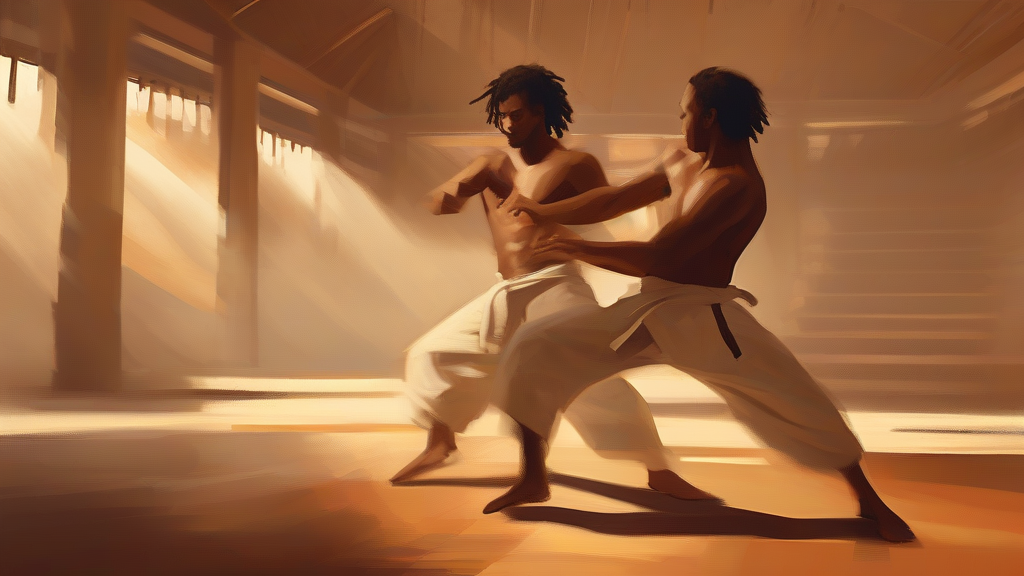
What does capoeira mean?
Capoeira is an Afro-Brazilian martial art that fuses fighting, dancing, acrobatics, and live music into a single flowing discipline. Developed by enslaved Africans in Brazil, it was disguised as dance to evade suppression, which is why its kicks, spins, and low sweeping movements appear playful rather than aggressive. Practitioners typically perform inside a circle known as a roda, accompanied by percussion instruments such as the berimbau, while pairs exchange non-contact movements in a call-and-response rhythm. Today capoeira is taught worldwide as both a physical practice and a living cultural tradition, valued for building strength, coordination, and community. In English usage it functions as an uncountable noun — one trains, plays, or performs capoeira — and it carries connotations of grace, resilience, and Afro-Brazilian heritage that make it distinctive among the world's martial arts.
nounAn Afro-Brazilian martial art that blends dance, acrobatics, and rhythmic movement, performed to traditional music and historically practised by enslaved Africans in Brazil.
- The Afro-Brazilian martial art combining elements of dance, acrobatics, and music, traditionally performed within a circle called a roda.
"The two performers flowed around each other in the roda, their capoeira movements equal parts fight and dance."
"She has been training capoeira for three years and now leads beginner classes at her studio in Lisbon."
"In Salvador da Bahia, street performers drew a crowd with a dazzling display of capoeira set to berimbau music."
Rarely pluralised; used mainly when distinguishing distinct styles, schools, or individual performances of capoeira.
"The festival showcased several regional capoeiras, each with its own musical style and rhythm."
Capoeira was once outlawed in Brazil — practitioners had to hide it behind music and dance, which is why it looks like a fight choreographed by a drummer.
Reviewed by Deb Chak, Editor. AI-assisted content curated by RJS Tech Solutions LLP.
Etymology of capoeira
Capoeira derives from Portuguese, where it originally referred to a low woodland or scrub area — from 'caá' (forest/vegetation) plus 'puera' (gone/past) in Tupi-Guarani. The martial art took its name from these marginal lands on the outskirts of colonial Brazilian settlements, where enslaved people are said to have gathered to practise. The word entered English in reference to the martial art during the twentieth century as capoeira gained international recognition following Brazil's cultural exports and its eventual legalisation in the country.
How capoeira is actually used
Capoeira is an uncountable noun when referring to the art itself, though it can be used countably to refer to a specific practice or performance. It is always lowercase except at sentence start. The word is strongly associated with Brazilian culture and is often used with terms like 'roda', 'berimbau', 'ginga', and 'mestre'.