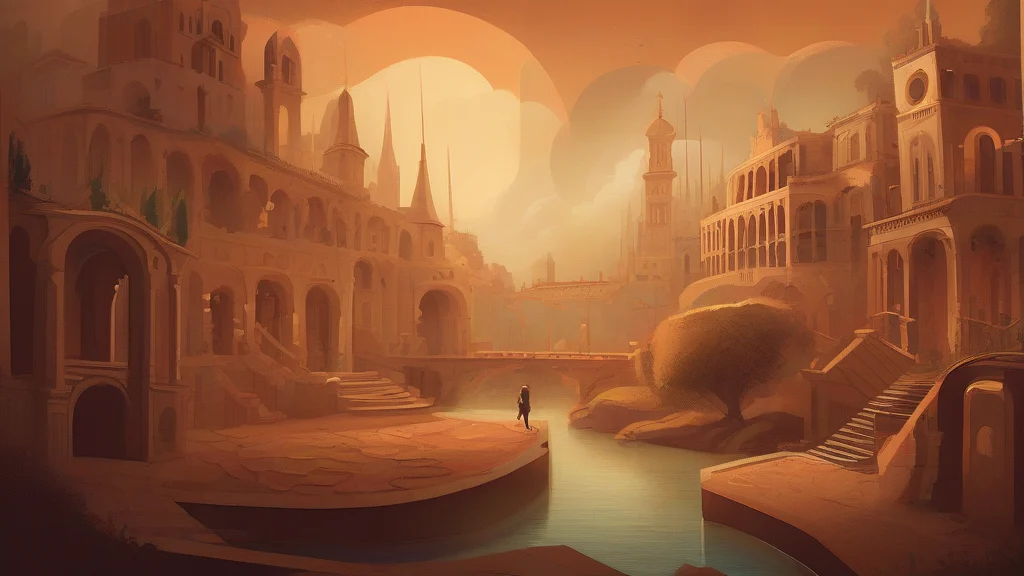
What does capriccio mean?
A capriccio is a composition — usually musical, sometimes pictorial — defined by its freedom and fanciful spirit. In music, it names a lively instrumental piece that ignores strict form, delighting instead in sudden shifts of mood, tempo, and texture; famous examples include works by Tchaikovsky, Paganini, and Liszt. In painting, particularly Venetian art of the eighteenth century, a capriccio is an architectural fantasy in which real monuments, ruins, and invented buildings are jumbled into a single imagined scene, popularised by artists such as Canaletto and Guardi. Both senses share a core idea: creative licence unconstrained by rules. The word comes from the Italian for 'whim' or 'sudden start', which may ultimately trace back to a Latin root meaning 'goat', evoking the animal's sudden leaps. Though specialised, capriccio is a useful word for describing anything exuberantly inventive, and it lends a touch of sophistication to writing on music, art, or imagination itself.
A free, lively instrumental composition characterised by playfulness, irregularity, and often virtuosity.
"Tchaikovsky's Italian Capriccio brims with melodies gathered during his visit to Rome."
In music, the term signals deliberate freedom from conventional structure such as sonata form.
An architectural or landscape fantasy painting that combines real and imaginary elements in one fanciful scene.
"Canaletto painted a celebrated capriccio placing Venice's campanile beside ancient Roman arches."
This sense is largely confined to art-historical contexts and descriptions of Venetian vedute painters.
Both the anglicised plural 'capriccios' and the Italian 'capricci' are accepted; the latter is more common in specialist musicological and art-historical writing.
"The programme featured three capriccios written for solo cello."
Its Italian root may go back to the word for 'goat' — as if the music were frisking about like a kid on a hillside.
Reviewed by Deb Chak, Editor. AI-assisted content curated by RJS Tech Solutions LLP.
Etymology of capriccio
Capriccio was borrowed from Italian in the late seventeenth century, where it meant 'whim' or 'freak of fancy'. The Italian noun derives from capriccio 'shudder, sudden start', related to capra 'goat', from Latin caper, suggesting the sudden leaping motion of a goat. English adopted the word chiefly through music criticism and, later, art history, giving it the two modern senses it retains today. Its cousin caprice entered English earlier by way of French.
Related word forms
How capriccio is actually used
Capriccio retains its Italian flavour and appears mainly in formal writing about music and art history; plural forms are both 'capriccios' and the Italian 'capricci'. In music it often carries a connotation of virtuosic brilliance and spontaneity.
Easily confused with capriccio
Caprice means a sudden, unaccountable change of mood or behaviour (and can also name a similar short musical piece), whereas capriccio refers specifically to the musical composition or the fantasy painting genre.
A concerto is a structured work for solo instrument and orchestra, while a capriccio is a free, unstructured piece not bound to conventional form.