What does capybara mean?
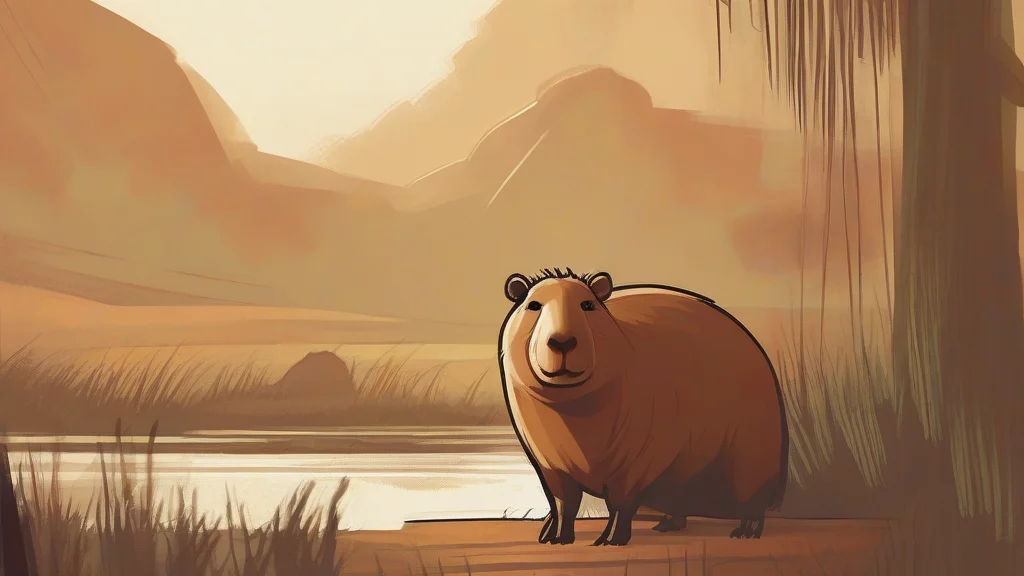
A capybara is a large, semi-aquatic rodent native to South America, and it holds the distinction of being the biggest living rodent on Earth. Reaching up to about sixty-five kilograms, it resembles an outsized guinea pig, with a stocky body, short legs, coarse brown fur, and eyes set high on its head — an adaptation for swimming while keeping watch above water. Capybaras live in family groups near rivers, marshes, and lakes throughout much of the continent, grazing on aquatic plants and grasses. In everyday English the word functions simply as a countable noun, appearing in wildlife documentaries, zoological texts, and travel writing. Beyond its literal sense, 'capybara' has acquired a warm cultural connotation thanks to the animal's famously unflappable temperament: images of birds and monkeys perching calmly on capybaras have made them beloved figures online. For English speakers, the word is useful both in natural-history contexts and in any discussion of unusual animals.
nounA large, semi-aquatic South American rodent (Hydrochoerus hydrochaeris), the largest living rodent in the world, typically found near water in grasslands and forests. It is a social animal known for living in groups and its calm temperament.
- The largest living rodent, a semi-aquatic mammal native to South America, closely related to guinea pigs.
"The capybara waded into the river at dusk, joining the rest of its herd."
"Visitors to the wildlife park gathered around the enclosure to watch a capybara lounging in a shallow pool."
"In parts of South America, capybaras are hunted for meat and leather, though they remain widespread across their range."
Standard pluralization adds -s. Occasionally 'capybara' appears unchanged when used as a mass noun for the animal's meat or hide.
"Herds of capybaras gather along the riverbank during the dry season."
Capybaras are so famously relaxed that other animals — birds, monkeys, even turtles — regularly hitch a ride on their backs, earning them the title of nature's friendliest couch potato.
Reviewed by Deb Chak, Editor. AI-assisted content curated by RJS Tech Solutions LLP.
Etymology of capybara
The word 'capybara' entered English in the early seventeenth century via Portuguese, which borrowed it from Tupi, an indigenous language of coastal Brazil. In Tupi it derives from 'ka'apiûara', a compound meaning roughly 'grass eater' — from elements referring to grass and eating — a fitting name for an herbivorous grazer. Spanish adopted a parallel form, 'capibara' or 'chigüire' in some regions, and related vernacular names persist across South America. Its closest linguistic relatives are not European cognates but fellow loanwords from indigenous South American languages, such as those naming the guinea pig ('cuy' from Quechua).
How capybara is actually used
The plural is most commonly 'capybaras', following standard English pluralization; 'capybara' without a plural marker is occasionally used as a mass noun referring to the animal's flesh or in loose collective reference. The word carries no particular register constraints and appears equally in scientific writing, travel journalism, and casual internet culture, where the animal's placid demeanor has made it a popular meme subject.
Easily confused with capybara
A beaver is a large semi-aquatic rodent of the Northern Hemisphere known for building dams, whereas a capybara is a much larger South American rodent that does not build dams and more closely resembles an enormous guinea pig.
The nutria or coypu is a medium-sized semi-aquatic rodent with a long rat-like tail, while the capybara is far larger, has a barrel-shaped body, and only vestigial tail.