
What does carambole mean?
Carambole carries two distinct meanings that share a single spelling. Most commonly encountered in food writing, it names the star fruit — the glossy, ridged fruit of the tropical tree Averrhoa carambola, which turns up as neat five-pointed stars when sliced across its width. Its flesh is crisp and juicy, with a sweet-tart flavour that suits salads, garnishes, and drinks. The word's second life belongs to the billiard room: in carom games, a carambole is a stroke in which the cue ball glances off one object ball to strike another, a manoeuvre English speakers usually call a cannon or a carom. This sporting sense extends figuratively to any indirect, ricochet-like effect. Because English speakers typically reach for 'star fruit' or 'carambola' for the fruit and 'carom' for the shot, 'carambole' remains relatively rare in English text, lending whatever uses it does find a distinctly French inflection.
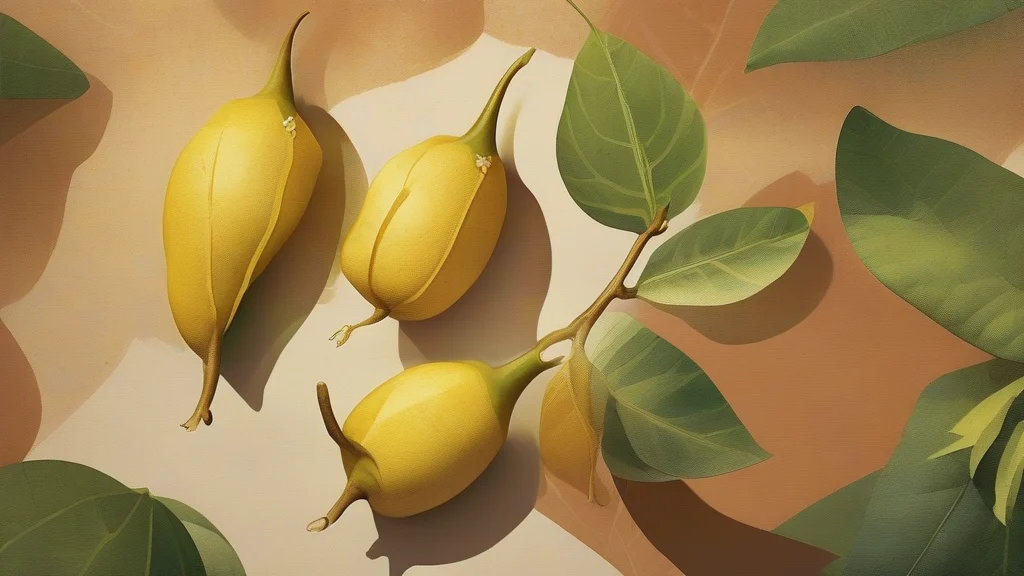
The star fruit: the edible yellow-green fruit of Averrhoa carambola, star-shaped in cross-section.
"A few slices of carambole lent the punch a decorative, citrusy brightness."
In carom billiards, a stroke in which the cue ball strikes both object balls; figuratively, any indirect, ricocheting effect.
"Her shot ended in a clean carambole, the cue ball kissing the red before toppling the white."
Standard plural, used for multiple fruits or multiple billiards strokes.
"He arranged three ripe caramboles on the platter like a constellation."
Cut a carambole crosswise and it reveals a perfect star — nature's own garnish, hiding in plain sight on the fruit stand.
Reviewed by Deb Chak, Editor. AI-assisted content curated by RJS Tech Solutions LLP.
Etymology of carambole
English borrowed 'carambole' from French, where it serves double duty as both the fruit and the billiards term. The billiards sense arose in France, probably by extension of the earlier fruit word, and gave rise to the anglicised forms 'carom' and the Indian game name 'carrom'. The fruit name itself traces back through Portuguese 'carambola' — the source of the English 'carambola' — which is generally thought to derive from a South Asian language such as Marathi 'karambal'. The word thus travelled from India via Portuguese into French and finally into English.
How carambole is actually used
As the fruit name, 'carambole' is the French form; English speakers more often say 'carambola' or 'star fruit', so 'carambole' may read as slightly Gallic or technical in English food writing. In billiards, English-language players overwhelmingly prefer 'cannon' or 'carom'; 'carambole' survives mainly in French-influenced contexts such as 'billard à caramboles' (carom billiards). The word is therefore uncommon in everyday English and carries a mildly continental flavour.
Easily confused with carambole
Carom is the standard English term for the two-ball contact shot in billiards, while carambole is chiefly the French term for that shot or the name of the star-shaped tropical fruit.
Carambola refers specifically to the star fruit itself (the tree and its fruit), whereas carambole can denote either the fruit (via French usage) or, in billiards, the cannon shot.