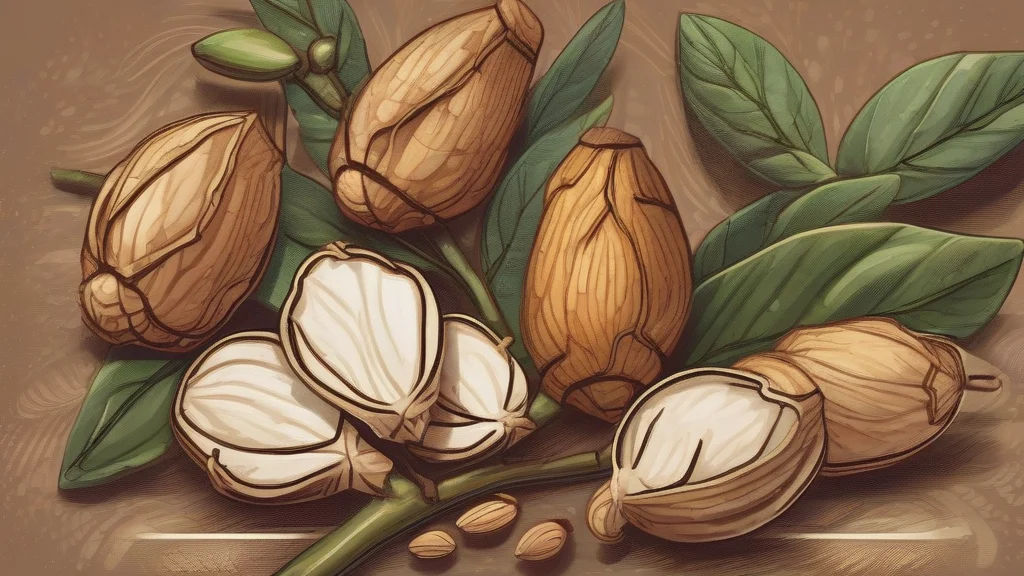
What does cardamom mean?
Cardamom is a spice consisting of the small, aromatic seeds — and their enclosing seed pods — of Elettaria cardamomum, a perennial plant of the ginger family native to southern India. It ranks among the world's most expensive spices after saffron and vanilla, prized for an intensely fragrant flavor that is simultaneously sweet, warm, resinous, and faintly citrusy, with hints of eucalyptus. Cardamom is indispensable in Indian and Middle Eastern cooking, appearing in curries, biryanis, garam masala, chai, and Arabic coffee, while Scandinavian bakers use it generously in pastries and breads. The word also denotes the plant itself, now widely cultivated in Guatemala as well as India and Sri Lanka. Both green and black varieties exist, differing in intensity and character. With its exotic connotations and unmistakable perfume, cardamom carries strong associations of warmth, hospitality, and festive baking.
The aromatic seeds or seed pods of Elettaria cardamomum, used as a spice.
"Chew on a cardamom pod to freshen your breath."
Often uncountable when referring to the ground spice ('a pinch of cardamom') and countable when referring to pods ('two cardamoms').
The tropical plant Elettaria cardamomum itself, native to southern India.
"The hillside plantations were covered in cardamom."
'Cardamoms' typically refers to individual seed pods; the ground spice is treated as an uncountable mass noun.
"Simmer the milk with a few crushed cardamoms before adding the tea leaves."
Cardamom was so prized by ancient Romans that Pliny the Elder complained it was worth more than almost any other spice imported from the East — and it's still called the 'Queen of Spices' today.
Reviewed by Deb Chak, Editor. AI-assisted content curated by RJS Tech Solutions LLP.
Etymology of cardamom
The English word 'cardamom' derives from Latin 'cardamomum', which itself comes from Greek 'kardamon', the name the Greeks applied to the spice. The ultimate origin of the Greek term may lie in Dravidian languages of southern India, where the plant is native, though this is uncertain. The word entered English in the early modern period, with forms like 'cardamome' attested by the sixteenth century. Cognates appear across European languages, including French 'cardamome' and German 'Kardamom', all tracing back to the same classical sources.
How cardamom is actually used
Both spellings 'cardamom' and 'cardamon' are accepted, though 'cardamom' is far more common. The plural 'cardamoms' usually refers to the individual pods. In British English it is sometimes pronounced with stress on the final syllable (/ˌkɑːdəˈmɒm/).
Easily confused with cardamom
A cardoon is a thistle-like vegetable related to the artichoke, whereas cardamom is a spice made from the seeds of a plant in the ginger family.