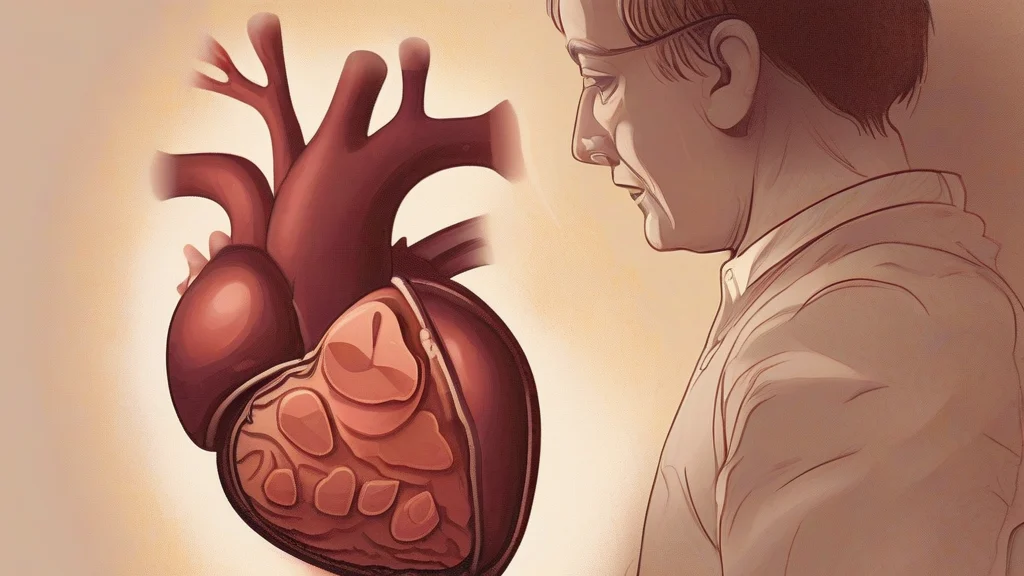
What does cardiomyopathy mean?
Cardiomyopathy refers to any disease affecting the heart muscle — the myocardium — that impairs its ability to pump blood efficiently. Rather than naming one illness, the term describes a family of disorders broadly grouped into dilated, hypertrophic, and restrictive forms, each altering the muscle's size, thickness, or stiffness in different ways. Unlike conditions driven primarily by clogged coronary arteries or chronic hypertension, cardiomyopathy arises from changes in the muscle tissue itself, whether genetic, infectious, toxic, or idiopathic. The word appears almost exclusively in medical, scientific, and journalistic contexts, where it carries a serious clinical connotation. It can be treated as uncountable ('he has cardiomyopathy') or countable when distinguishing specific types ('the cardiomyopathies'). Derived from Greek roots meaning 'heart,' 'muscle,' and 'suffering,' the term is a precise, self-explanatory label that has become essential vocabulary for anyone following cardiac medicine or public-health coverage.
nounCardiomyopathy is a disease of the heart muscle in which the muscle becomes enlarged, thickened, or stiff, weakening its ability to pump blood effectively. It is not a single condition but a group of disorders of the myocardium that are distinct from diseases caused by blocked arteries or high blood pressure alone.
- Any disease of the heart muscle (myocardium) that impairs its structure or function, typically classified into types such as dilated, hypertrophic, and restrictive.
"After months of unexplained fatigue, she was diagnosed with dilated cardiomyopathy."
"Hypertrophic cardiomyopathy is one of the most common inherited heart conditions worldwide."
"The athlete's sudden collapse on the field was later attributed to an undiagnosed cardiomyopathy."
Typically used only in clinical or academic writing to refer collectively to the different recognized types of the disease.
"Genetic testing now plays a central role in diagnosing inherited cardiomyopathies."
The word cardiomyopathy is built entirely from Greek — 'kardia' (heart), 'mys' (muscle), and 'pathos' (suffering) — so it literally means 'suffering heart muscle,' a diagnosis encoded in its own name.
Reviewed by Deb Chak, Editor. AI-assisted content curated by RJS Tech Solutions LLP.
Etymology of cardiomyopathy
Cardiomyopathy is a modern medical compound assembled from three ancient Greek roots: 'kardia' meaning heart, 'mys' meaning muscle, and 'pathos' meaning suffering or disease. Such Greco-Latin compounds were coined by European physicians during the nineteenth and early twentieth centuries as anatomy-based nomenclature spread through medical science, and 'cardiomyopathy' entered English usage within that tradition. It shares its building blocks with cognate terms such as cardiology, myopathy, and pathology.
Related word forms
How cardiomyopathy is actually used
Cardiomyopathy is a formal medical term used chiefly by clinicians and in health reporting; in everyday conversation speakers usually say 'a heart condition' or 'heart muscle disease.' It functions as both a count noun ('a cardiomyopathy') and an uncountable mass noun ('she has cardiomyopathy'), with the plural 'cardiomyopathies' referring to distinct types.
Easily confused with cardiomyopathy
A cardiologist is a physician who specializes in the heart, whereas cardiomyopathy is itself a disease of the heart muscle.