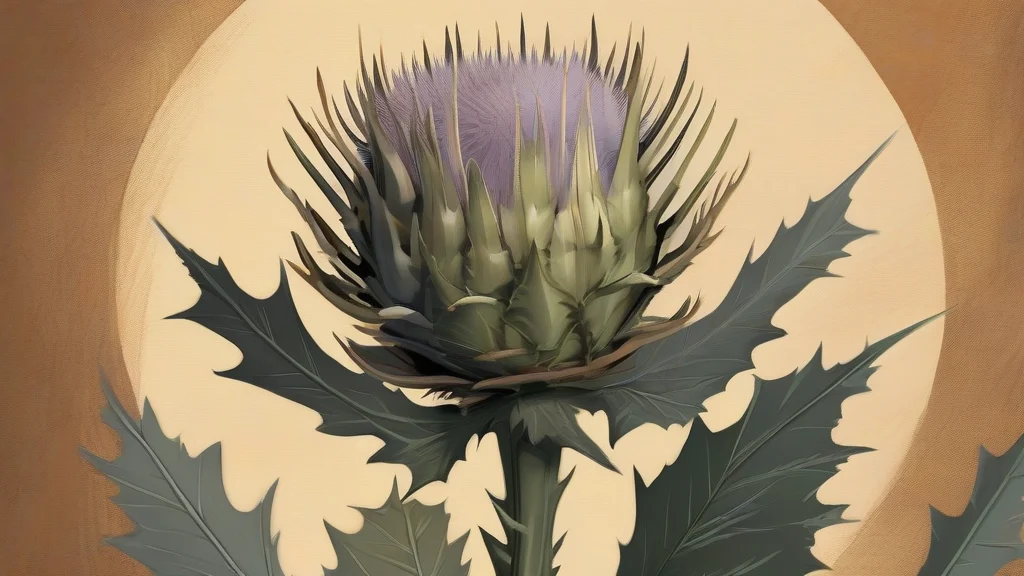
What does cardoon mean?
The cardoon is a large, thistle-like plant of the Mediterranean region, a close relative of the globe artichoke that belongs to the daisy family. Where the artichoke is prized for its flower bud, the cardoon is grown for its thick, fleshy leaf stalks, which must be blanched — shielded from light as they mature — to soften their natural bitterness before cooking. Once prepared, they are commonly braised, fried in batter, or baked in gratins, and they feature prominently in Italian, Spanish, Provençal, and North African cooking, often appearing on festive winter tables. The word also refers to those stalks themselves once harvested as a vegetable. Though rarely seen in ordinary supermarkets outside specialist markets, cardoon has a long culinary history stretching back to antiquity and remains a cherished seasonal ingredient wherever it is grown, valued for its delicate, slightly bitter flavor and its striking ornamental presence in the garden.
A Mediterranean thistle-like plant (Cynara cardunculus) of the daisy family, closely related to the globe artichoke and cultivated for its edible blanched leaf stalks.
"The gardener tied the cardoon leaves together so the inner stalks would blanch in time for winter."
Often used in horticultural contexts; the plant is also grown ornamentally for its silvery foliage and purple flowers.
The thick, blanched leaf stalks of this plant, cooked and eaten as a vegetable.
"She simmered the cardoons in lemon water to keep them from discoloring before adding them to the gratin."
Used as both a count noun ('three cardoons') and a mass noun ('a dish of cardoon').
Regular plural. When referring to the prepared vegetable as a dish or ingredient in bulk, the uncountable singular 'cardoon' is also common.
"Markets in Provence sell cardoons throughout the winter months."
Before it was food, the cardoon was a weed — a wild Mediterranean thistle that people spent centuries taming into dinner.
Reviewed by Deb Chak, Editor. AI-assisted content curated by RJS Tech Solutions LLP.
Etymology of cardoon
Cardoon entered English in the early 17th century by way of French cardon, itself borrowed from Italian cardone, an augmentative form of cardo meaning 'thistle'. These words ultimately descend from Latin carduus, 'thistle' or 'wild artichoke'. The same Latin root gives us chard, another vegetable name that traveled through French into English.
How cardoon is actually used
Cardoon is a somewhat formal or culinary term, encountered mainly in gardening writing and European cookery, especially in Italian, Spanish, Provençal, and North African cuisines. The plural is regular.
Easily confused with cardoon
Chard is a leafy beet green eaten for its leaves, whereas cardoon is a thistle whose thick leaf stalks are the edible part.
The globe artichoke is eaten for its immature flower bud, while the cardoon is cultivated for its fleshy leaf stalks.