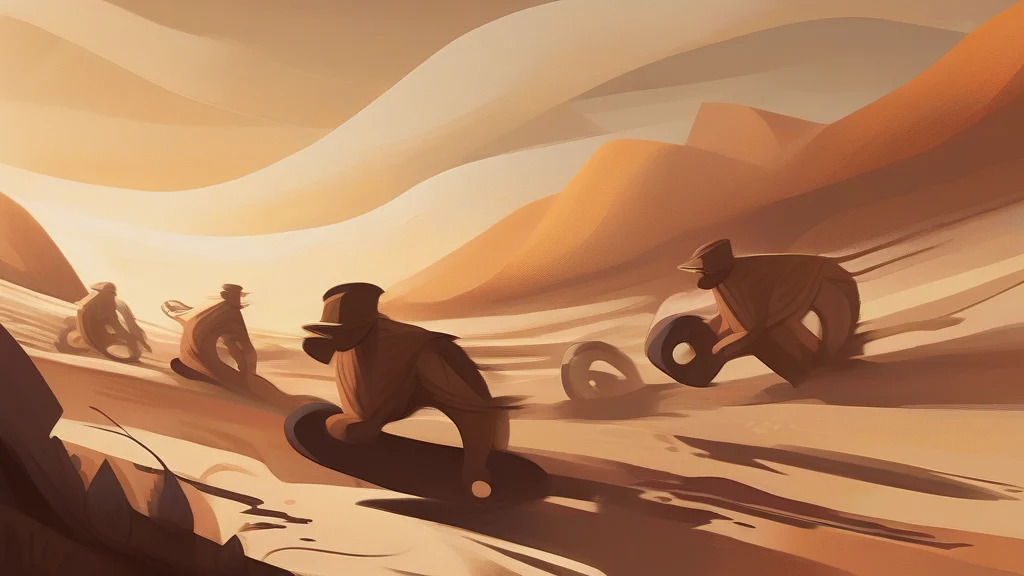
What does careering mean?
Careering is the present participle of the verb 'to career', meaning to move rapidly and uncontrollably in a particular direction. A lorry might come careering down a hill, or an excited child come careering into a room. The word nearly always implies speed combined with a loss of control or a hint of danger; nobody careers calmly. It is most commonly encountered in the continuous forms 'went careering' or 'came careering', typically followed by a preposition indicating direction — down, into, off, along. Although the noun 'a career' refers to one's working life, the verb belongs to an older sense of 'career': a swift, unimpeded course or gallop, from the Latin carraria, a carriage road. That makes careering etymologically kin to such everyday words as car, cart, carry, and carriage. In American English it is frequently confused with 'careening', which strictly means lurching or swaying sideways rather than rushing forward. Vivid and kinetic, careering is a favourite of journalists and novelists describing anything from runaway vehicles to chaotic events.
verb (present participle of 'career')Moving swiftly and often uncontrollably in a specified direction; rushing headlong.
- To move swiftly and uncontrollably in a particular direction, especially recklessly or dangerously.
- (Rare, archaic sense of the base verb) To rush headlong through one's course or activity.
"The runaway cart came careering down the steep cobbled street."
"A cyclist went careering past us on the narrow lane."
"The toddler came careering across the playground with arms outstretched."
The same Latin root that gave us 'career' also gave us 'cart' — a career was originally a racecourse, so to go careering is literally to run the track at full gallop.
Reviewed by Deb Chak, Editor. AI-assisted content curated by RJS Tech Solutions LLP.
Etymology of careering
Careering derives from the verb 'career', borrowed in the sixteenth century from the noun meaning a course or gallop, which came via French carrière from the medieval Latin carraria — a road wide enough for wheeled vehicles, formed on carrus, a wagon. This Latin root is shared with the everyday words car, cart, carriage, and carry. Originally used of horses running at full speed around a course, the verb shifted by the seventeenth century to describe any rapid, uncontrolled movement, and that is the sense that survives today.
Related word forms
How careering is actually used
Almost always carries a connotation of loss of control, speed, or danger — it is rarely used neutrally. It appears almost exclusively in the progressive form ('was careering', 'went careering'), rarely as a simple past participle. In American English it is sometimes conflated with 'careening'.
Easily confused with careering
'Careering' means moving fast and wildly in a direction, while 'careening' means swaying or lurching from side to side (originally of a ship tilted for repairs) — though American usage increasingly blends the two.