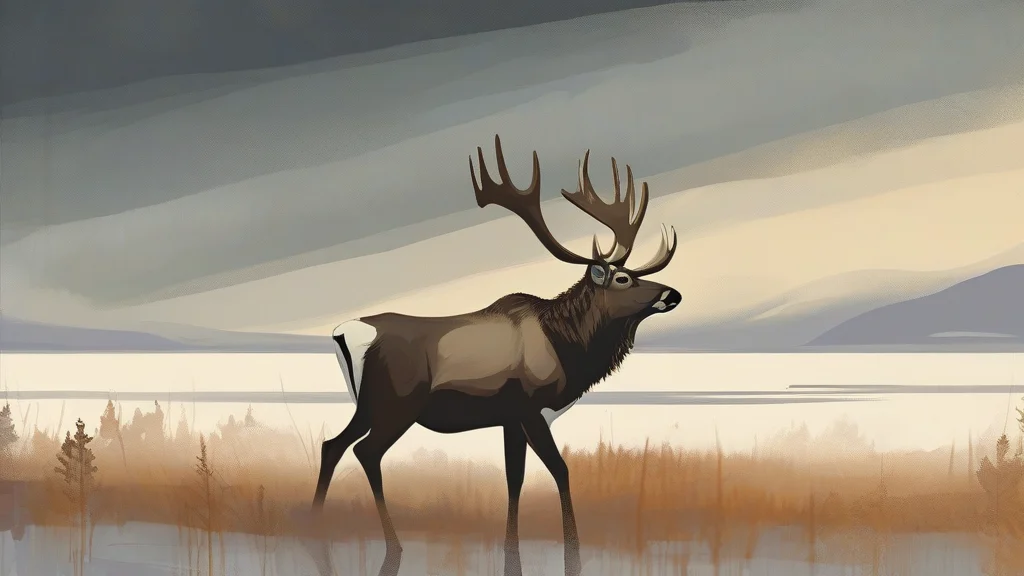
What does caribou mean?
The caribou is a large, cold-adapted deer native to the Arctic and subarctic regions of North America, belonging to the species Rangifer tarandus. Unlike most other deer, both males and females grow antlers, an unusual trait that helps females defend winter feeding grounds and dig through snow for lichen. Caribou are famous for their extraordinary migrations, with some herds traveling thousands of kilometres each year between calving grounds on the tundra and wintering areas in the boreal forest. The word is the North American equivalent of 'reindeer': in Eurasia the animal is called a reindeer, and the term there usually implies domestication, whereas caribou generally refers to the wild North American populations. For Indigenous peoples across Canada and Alaska, the caribou has been central to subsistence, culture, and identity for millennia. Ecologically, it is a keystone species of the far north, though several woodland herds are now threatened by habitat loss and climate change. The plural of the word is also caribou.
nounA large deer of the Arctic and subarctic regions of North America, having antlers in both sexes and adapted for life on tundra and boreal forest. The North American counterpart of the Eurasian reindeer.
- The wild North American reindeer (Rangifer tarandus), a large gregarious deer of tundra and boreal regions with antlers present in both sexes.
"Each autumn the herd of caribou crossed the frozen river on its long southward migration."
"Thousands of caribou streamed across the tundra during the spring migration."
"For centuries, Indigenous peoples of the far north have depended on the caribou for food, clothing, and tools."
'Caribou' is a zero-plural noun: the singular and plural forms are identical. Using 'caribous' is grammatically possible but uncommon and generally avoided in careful writing.
"We watched a dozen caribou grazing along the ridge at dusk."
Caribou are the only members of the deer family in which females grow antlers too — and they keep them all winter while males shed theirs after the rut.
Reviewed by Deb Chak, Editor. AI-assisted content curated by RJS Tech Solutions LLP.
Etymology of caribou
The word 'caribou' entered English in the early 17th century through Canadian French, which borrowed it from a Mi'kmaq (Algonquian-language) word, often cited as qalipu, meaning roughly 'the one who paws/shovels snow'. It thus belongs to the small group of English words of Native American origin that describe uniquely North American animals. Its closest relative among common English words is 'Carib', another Algonquian-era borrowing applied to indigenous peoples of the Caribbean region, though the two developed separately.
How caribou is actually used
The word functions identically in singular and plural ('one caribou', 'several caribou'); forms like 'caribous' are rare. In North America it typically denotes wild animals, while 'reindeer' is used for the domesticated or Eurasian ones. It is standard in formal, scientific, and everyday registers alike, and carries strong associations with northern wilderness and Indigenous cultures.
Easily confused with caribou
Reindeer refers to the same species in Eurasia (and domesticated forms), while 'caribou' is the term used in North America, especially for wild populations.
A moose is a much larger North American deer species with broad palmate antlers, whereas the caribou is smaller and has branching, curved antlers in both sexes.