
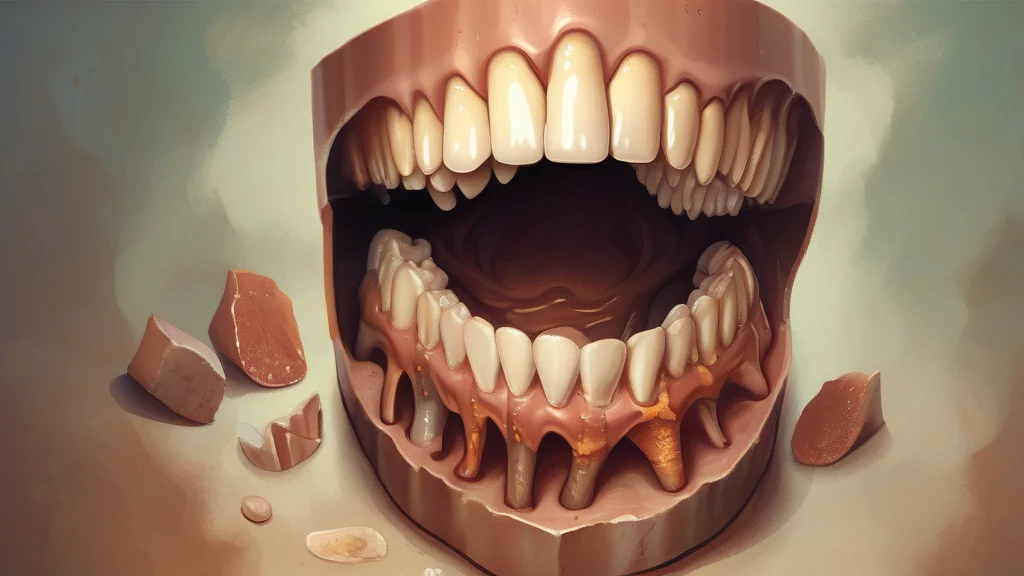
What does caries mean?
Caries refers to the gradual decay and destruction of hard tissue in the body, most commonly tooth structure and, in older medical usage, bone. In modern practice the word is overwhelmingly associated with dentistry, where "dental caries" is the clinical name for what most people call tooth decay or cavities — a process in which bacteria in plaque produce acids that dissolve enamel and, if unchecked, the deeper dentine. The term carries a distinctly professional register: it dominates dental textbooks, public-health reports, and insurance documents, while everyday conversation favors simpler phrasing. Grammatically it behaves as an uncountable noun, so one speaks of "extensive caries" rather than "several caries." Derived from Latin caries, meaning rot or putrefaction, the word preserves an ancient metaphor linking biological decay with general corruption, and its adjective form, carious, remains standard in clinical description.
Progressive decay of tooth structure caused by acid-producing bacteria; the clinical term for tooth decay.
"Fluoride varnish is applied twice yearly to help prevent caries in children's teeth."
Used as an uncountable mass noun; the form is identical in singular and plural reference.
Chronic, destructive decay or necrosis of bone, a sense now largely historical in medical usage.
"Nineteenth-century surgeons described caries of the jaw as a common complication of untreated infection."
"Caries" is typically treated as uncountable; when a plural sense is needed, the same form is used, often with a quantity expression such as "multiple areas of caries."
"The examination found caries in several teeth on both sides of the mouth."
Dentists say you have caries, not just cavities — it's the same word the ancient Romans used for anything rotting away.
Reviewed by Deb Chak, Editor. AI-assisted content curated by RJS Tech Solutions LLP.
Etymology of caries
Caries comes directly from the Latin noun caries, meaning rot, putrefaction, or decay, which was applied both to decaying organic matter and to crumbling bone. English adopted the term in the seventeenth century, initially in medical writing about diseased bone before it became firmly attached to dentistry. The related adjective carious derives from the same Latin source, and the underlying idea of eating away or corruption links the word conceptually to other terms of gradual destructive decay.
Related word forms
How caries is actually used
"Caries" is a formal, technical term used almost exclusively by dentists, physicians, and public-health writers; lay speakers nearly always say "tooth decay" or "cavities." It is an uncountable mass noun in ordinary use and its form does not change in the plural. It appears frequently in epidemiological contexts such as "dental caries prevalence."
Easily confused with caries
"Carries" is the verb "carry" in the third-person singular (he carries the box), whereas "caries" is the noun meaning decay of teeth or bone.
"Carious" is the adjective form meaning affected by caries, as in "a carious molar," while "caries" is the noun naming the condition itself.