What does carman mean?
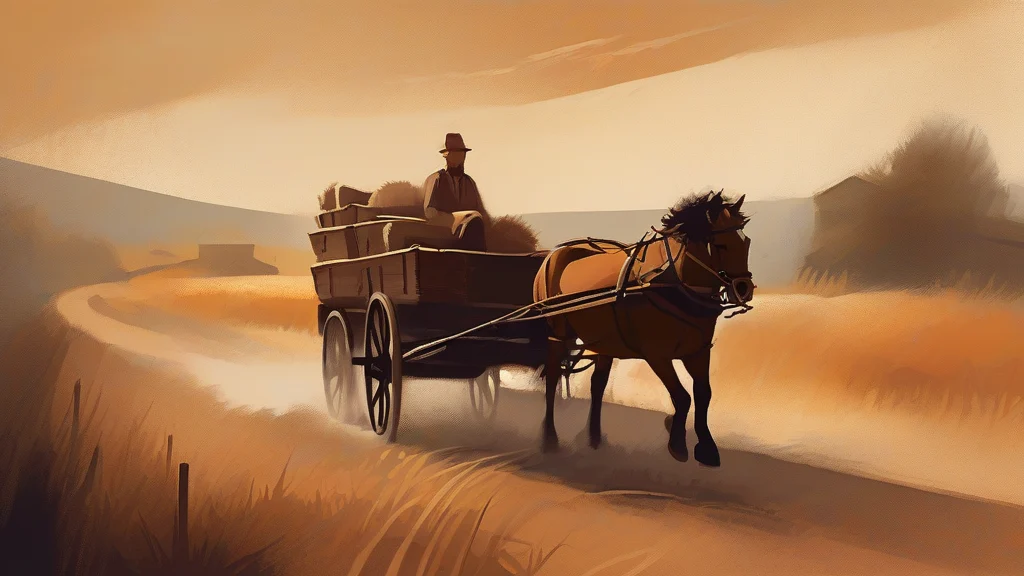
A carman was a man whose livelihood depended on a horse and cart: he drove a wheeled vehicle, usually for hire, moving goods between warehouses, markets, docks, and shops. The term flourished in Britain during the eighteenth and nineteenth centuries, when urban commerce relied on fleets of these licensed carriers, and it appears frequently in census records and trade directories of the era. With the arrival of motor lorries in the early twentieth century, the carman's trade — and the word itself — faded into history, surviving mainly in genealogical research, period fiction, and as an inherited surname. The word carries a nostalgic, working-class connotation, evoking the clip-clop rhythm of pre-industrial city streets. Anyone researching ancestors or reading Victorian literature will encounter it often enough that knowing its precise meaning — a professional cart driver, not merely any traveller by car — proves genuinely useful.
A man whose work is driving a cart, especially one hired to transport goods; historically, a licensed urban carrier.
"The carman waited outside the bonded warehouse with his dray piled high with crates."
Chiefly British and now largely historical; encountered in records from roughly the seventeenth century to the early twentieth.
An English surname originating from this occupation.
"Mr Carman has lived in the village all his life."
Regular plural; note that 'Carmen' capitalized is unrelated — it is a personal name.
"The street was jammed with carmen unloading their wares at first light."
Before vans and lorries, every city's freight moved on the shoulders of the humble carman — so essential that London required them to be officially licensed.
Reviewed by Deb Chak, Editor. AI-assisted content curated by RJS Tech Solutions LLP.
Etymology of carman
The word 'carman' combines 'car', meaning a wheeled vehicle, with the agent suffix '-man'. The element 'car' traces back through Anglo-Norman and Old Northern French 'carre' to the Latin 'carrus', a two-wheeled wagon, which also gives us 'carriage', 'carry', 'cargo', and 'chariot'. The occupational compound arose in medieval and early modern English to denote a driver or haulier of carts. Its decline parallels that of horse-drawn freight transport in the twentieth century.
How carman is actually used
The word belongs chiefly to British English and carries a distinctly period flavour today; modern equivalents such as 'driver', 'hauler', or 'courier' have replaced it in everyday speech. It survives most often in historical writing, genealogy, and as a family name. In North America, 'teamster' filled much the same role.
Easily confused with carman
'Carmen' (capital C) is a female given name and the title of Bizet's opera, whereas 'carman' is a common noun for a cart driver.
A cartman is specifically the driver of a cart, while 'carman' was the broader official term for a licensed goods-carrier, though in many contexts they overlap.