What does caroche mean?
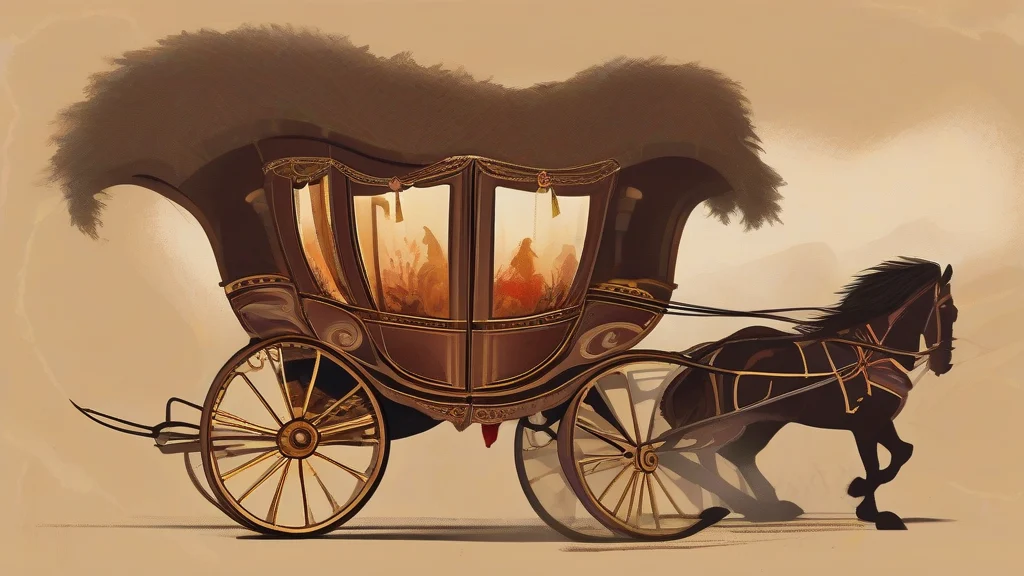
A caroche is a grand, richly ornamented horse-drawn carriage, particularly the ceremonial state coaches used by monarchs, ambassadors, and other members of the European nobility during the sixteenth and seventeenth centuries. The word entered English from continental sources and was applied to vehicles that were designed less for convenience than for spectacle: gilded panels, painted heraldry, velvet interiors, and teams of fine horses all proclaimed their owner's rank. Today, caroche survives almost entirely as a historical term. Readers encounter it in accounts of royal processions, in museum descriptions of preserved coaches, and in period novels seeking authentic detail. Because it names such a specific kind of vehicle—an object of pageantry rather than ordinary transport—it lends writing about the past an air of precision and colour. Though obsolete in daily use, the caroche remains a vivid emblem of an age when how one travelled spoke as loudly as where one was going.
nounA caroche is a large, stately, often elaborately decorated horse-drawn carriage, especially one used by nobility or royalty on formal occasions. The term is chiefly historical, referring to state coaches of the 16th and 17th centuries.
- A large, ornate ceremonial horse-drawn carriage used by nobility, especially in the 16th–17th centuries (now historical).
"The ambassador arrived at court in a gilded caroche drawn by six white horses."
"The queen's caroche, lacquered black and trimmed in gold leaf, turned slowly through the crowded street."
"Museum curators restored the seventeenth-century caroche to its original splendour."
"He stepped from his caroche and ascended the palace steps to the sound of trumpets."
Regular plural; used when referring to multiple ceremonial carriages.
"A procession of caroches carried the visiting dignitaries through the city gates."
Before limousines, Europe's most powerful figures rode in caroches—carriages so lavishly gilded they were as much a display of wealth as a means of travel.
Reviewed by Deb Chak, Editor. AI-assisted content curated by RJS Tech Solutions LLP.
Etymology of caroche
Caroche came into English in the late sixteenth century from French caroche, which derived ultimately from Italian carrozza, meaning a four-wheeled carriage. The Italian word traces back further to Late Latin carrus, a wheeled vehicle borrowed from Celtic, the same root that gives us modern words like car, carry, and cargo. As the grand state coaches of Italy spread northward across Europe, so did the word describing them, settling into English as a name for these symbols of aristocratic display.
How caroche is actually used
Caroche is an archaic or historical term; it appears mainly in historical writing, museum contexts, or period fiction rather than everyday speech. It carries connotations of wealth, ceremony, and aristocratic pomp.
Easily confused with caroche
A carriage is any horse-drawn passenger vehicle, while a caroche specifically denotes the grand, ornate state coaches of Renaissance and early modern Europe.