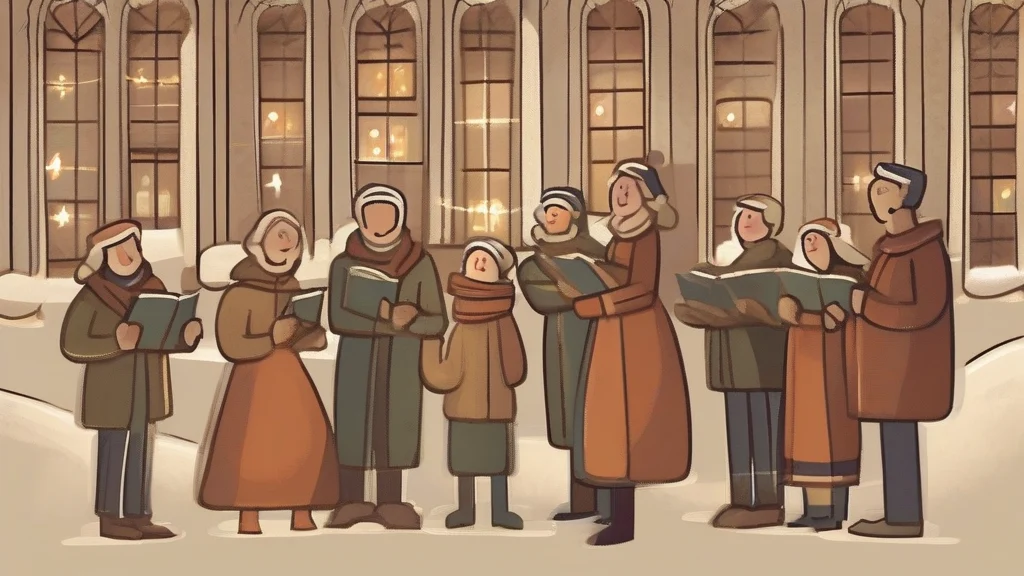
What does carolling mean?
Carolling is the act of singing carols — festive, often religious songs — most commonly associated with the Christmas season, when groups of singers go from house to house or gather in public places to perform. It functions both as a noun ('we joined the carolling in the square') and as the present participle of the verb 'to carol'. The word can also describe joyful singing more generally, particularly in literary or poetic contexts where birdsong is likened to song. In British English the spelling takes a double L ('carolling'), while American English favours 'caroling'; this follows standard conventions for doubling consonants after a short stressed vowel. The term carries warm, communal, and nostalgic connotations, evoking candlelit streets and shared celebration. Its history reaches back further than Christianity: 'carol' derives via Old French 'carole' from a medieval circle dance, meaning that modern carollers preserve, in song alone, an activity that was once danced as well as sung.
The act or practice of singing carols, especially Christmas carols, often by groups moving from place to place.
"The town's annual carolling drew crowds to the market square."
Chiefly British spelling; also written 'caroling' in American English.
Present participle of 'carol': to sing carols, or to sing in a cheerful, festive manner.
"They were carolling merrily as they walked home through the snow."
When used outside the Christmas context, the verb tends toward a poetic register.
Before it meant singing at all, a 'carole' was a medieval ring dance — so every Christmas caroller is echoing a dance that's been out of fashion for six centuries.
Reviewed by Deb Chak, Editor. AI-assisted content curated by RJS Tech Solutions LLP.
Etymology of carolling
The word derives from Middle English 'carolen', taken from Old French 'carole', which denoted a kind of ring dance accompanied by singing. The ultimate origin of the French term is uncertain, though some scholars link it to Latin 'choraula' (an accompanist to a chorus), from Greek 'choros', meaning a dance or chorus — making 'chorus' and 'choir' distant relatives. Over time the sense narrowed in English from dancing-and-singing generally to the singing of festive songs, and eventually became strongly tied to Christmas. The double-L spelling 'carolling' reflects British orthographic convention, while American usage prefers 'caroling'.
Related word forms
How carolling is actually used
The double-L spelling 'carolling' follows British convention for verbs ending in a stressed short vowel plus L; American English uses the single-L form 'caroling'. The word carries warm, festive connotations and leans slightly traditional or literary when used outside a Christmas context.
Easily confused with carolling
'Caroling' is simply the American English spelling of the same word, while 'carolling' with a double L is the standard British spelling.
A 'carillon' is a set of tuned bells played from a keyboard, whereas 'carolling' is the act of singing carols.