What does carpaccio mean?
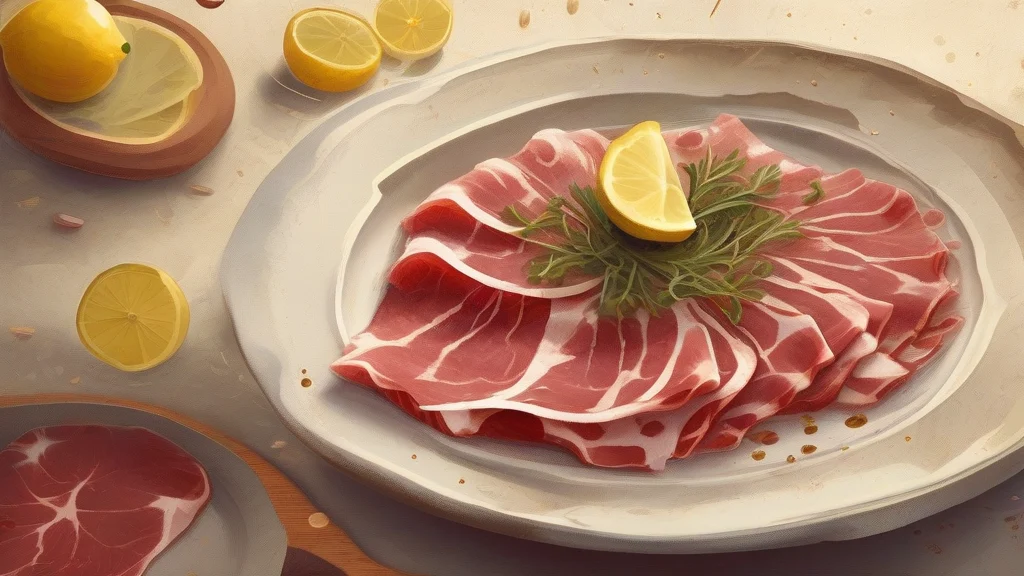
Carpaccio is a dish of meat or fish sliced so thin as to be nearly translucent, most classically raw beef dressed with olive oil and lemon juice and garnished with capers, onions, or shaved Parmesan. Served chilled as an appetizer, it is prized for its delicate texture and clean flavor. The name derives not from any ingredient but from the Venetian Renaissance painter Vittore Carpaccio, whose canvases are known for their deep red tones reminiscent of raw beef; the dish was created at Harry's Bar in Venice around 1950 for a countess whose doctor had prescribed raw meat. In contemporary usage the term has broadened to cover similar preparations of raw fish, and even thinly sliced raw vegetables or fruit, such as beetroot or pineapple carpaccio. The word belongs firmly to culinary, often upscale, contexts and signals refinement on a menu.
nounA dish consisting of very thinly sliced raw meat or fish, typically beef, dressed with olive oil and lemon juice and often served with capers or shaved Parmesan. By extension, the term is applied to similar dishes made with raw vegetables or fruit.
- A dish of very thinly sliced raw meat or fish, typically beef, served with a dressing of olive oil and lemon.
- Any analogous dish of thinly sliced raw vegetables or fruit prepared in a similar style.
"The starter was a delicate carpaccio of beef drizzled with olive oil and scattered with capers."
"The chef arranged the carpaccio in overlapping petals across a chilled plate, finishing it with lemon oil and shavings of Parmesan."
"For a lighter course, she prepared a carpaccio of golden beets with goat cheese and toasted walnuts."
The plural appears mainly when distinguishing different kinds of carpaccio on a menu or describing several servings; in ordinary reference to the food itself, the singular is used as an uncountable noun.
"The tasting menu featured two carpaccios, one of wagyu beef and one of scallop."
This elegant dish wasn't named after an ingredient at all — it was christened in 1950s Venice after a Renaissance painter famous for his vivid reds.
Reviewed by Deb Chak, Editor. AI-assisted content curated by RJS Tech Solutions LLP.
Etymology of carpaccio
The word carpaccio comes from Italian and honors Vittore Carpaccio (c. 1460–1526), the Venetian painter celebrated for the intense reds in his work, which were said to evoke the color of raw beef. It originated in Venice around 1950, when Giuseppe Cipriani of Harry's Bar devised the dish of paper-thin raw beef for Countess Amalia Nani Mocenigo, whose doctor had ordered her to eat raw meat. From its Venetian origin the term spread through international restaurant cuisine, eventually extending to comparable dishes made with fish, vegetables, and fruit. Because it derives from a proper surname rather than a classical root, it has no true cognates.
How carpaccio is actually used
The word carries a distinctly upscale, restaurant-menu register and is rarely used outside food contexts. It is usually treated as an uncountable mass noun ("some carpaccio") but takes plural agreement when referring to varieties or servings. The extended use for vegetable and fruit dishes is well established in modern restaurant usage, though purists reserve the term for raw meat or fish.
Easily confused with carpaccio
A carapace is the hard protective shell of an animal such as a turtle or crab, whereas carpaccio is a dish of thinly sliced raw meat or fish.
Tartare is finely chopped or minced raw meat or fish, while carpaccio consists of the same ingredients sliced paper-thin rather than minced.