What does carport mean?
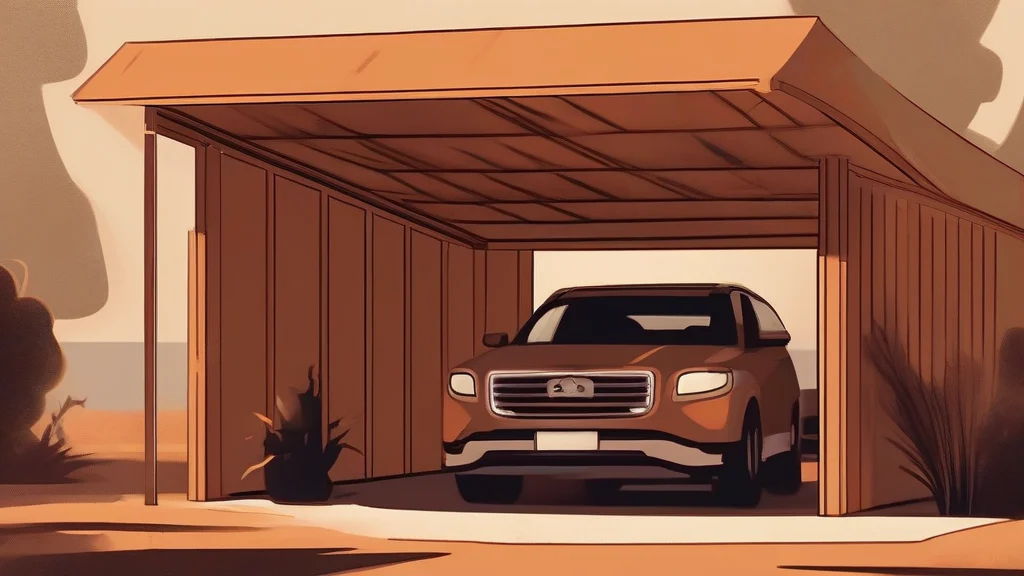
A carport is a covered structure designed to shelter cars and other vehicles, distinguished from a garage by being open on at least one side. Typically consisting of little more than a roof supported by posts, it may stand alone in a driveway or be attached to a house. Carports became widespread in mid-twentieth-century suburbia, valued as an inexpensive alternative to a fully enclosed garage; they protect vehicles from sun, rain, and light snow but offer no security against theft. In everyday use, the word appears in contexts such as real-estate listings, home improvement, and weather-related small talk ('park it under the carport'). Some homeowners repurpose them as outdoor living spaces, adding to their association with casual, domestic settings. The term is neutral in tone and understood throughout the English-speaking world, though it is most familiar in North America and Australia, where detached and attached carports remain common features of residential architecture.
nounA roofed structure, open on one or more sides, built to shelter a car or other vehicle, typically adjoining or near a house.
- A roofed, open-sided shelter for parking one or more vehicles, usually next to a home.
"She parked the car under the carport to shield it from the afternoon sun."
"Rain pattered on the metal roof of the carport as he unloaded the groceries."
"They converted the old carport into a shaded patio for summer evenings."
Regular plural formation. Used when referring to multiple structures, e.g. across a housing development or in construction contexts.
"Every unit in the complex had its own covered carports at the rear."
The word 'carport' was popularized by architect Frank Lloyd Wright, who insisted a house without walls around its car looked more honest — he called the enclosed version a 'garage' with disdain.
Reviewed by Deb Chak, Editor. AI-assisted content curated by RJS Tech Solutions LLP.
Etymology of carport
Carport is a twentieth-century English compound formed from 'car' (itself from Latin 'carrus', a wheeled vehicle) and 'port' (from Latin 'portus', meaning harbor or gateway). The term entered American English in the early decades of the automobile age and was notably championed by architect Frank Lloyd Wright, whose promotion of the open-sided car shelter helped establish the word in common usage. It shares its second element with words like 'portal', 'porch', and 'harbor', all tracing back to Latin roots connected with passage, gateways, or sheltered places.
How carport is actually used
Neutral in register and common in everyday speech across British and American English. The word is especially associated with mid-century suburban homes, particularly in North America and Australia, where carports were a standard feature of postwar housing. Unlike 'garage', it carries no connotation of storage or security — only weather protection.
Easily confused with carport
A garage is a fully enclosed structure with walls and a door, whereas a carport is open-sided and offers only a roof for shelter.