What does carrousel mean?
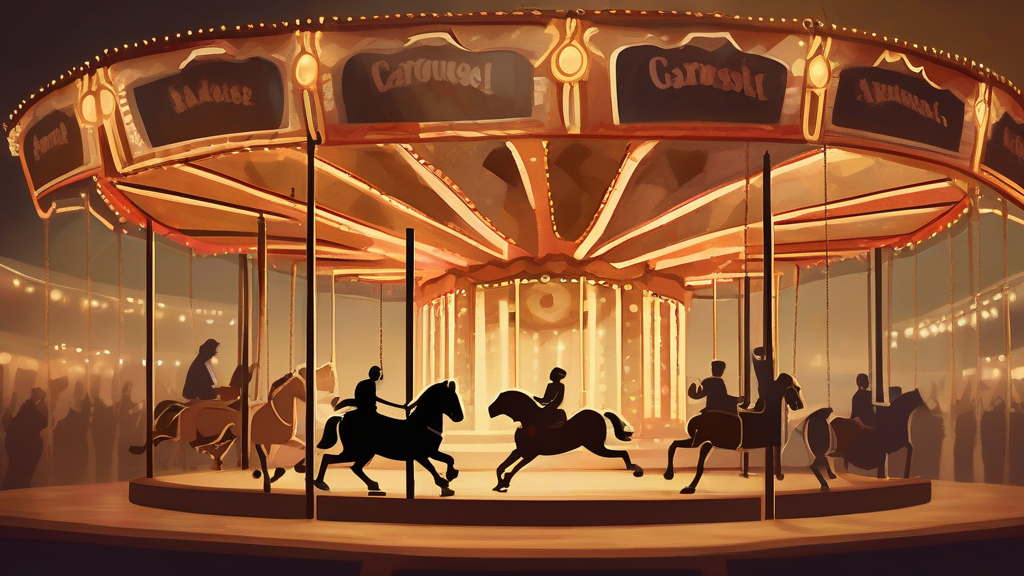
A carrousel is a revolving amusement ride consisting of a circular platform that turns around a fixed axis, on which riders sit atop carved or moulded animals — most often horses — or in decorative chairs. It is best known by its alternative name, the merry-go-round, and is a fixture of fairs, seaside promenades, and amusement parks, typically accompanied by music and ornate lighting. The word also has an older, largely historical sense: a carrousel was a grand public pageant of horsemanship, in which noblemen performed choreographed exercises and mock battles on horseback, popular at European courts in the seventeenth century. In modern usage "carrousel" is chiefly the French spelling of "carousel," lending a slightly continental, nostalgic flavour to the word. Its enduring association with gilded horses, childhood delight, and fairground atmosphere gives it strong evocative power, making it a favourite in descriptive writing about leisure, memory, and celebration.
A rotating amusement ride on which riders sit on decorated animal figures or in chairs mounted on a circular platform.
"The carrousel at the fairground dates back to the early twentieth century."
Often used interchangeably with "carousel," the dominant modern spelling; "carrousel" is preferred in French and in historical references.
A ceremonial display of horsemanship and martial exercises performed by knights or noblemen before spectators, especially in seventeenth-century Europe.
"The king presided over a magnificent carrousel in honour of the queen's birthday."
This sense is now chiefly historical and appears mainly in accounts of court life and equestrian spectacle.
Standard plural, formed by adding -s; used when referring to multiple rides or multiple historical pageants.
"Paris once hosted several celebrated carrousels in its royal squares."
Before it meant a merry-go-round, a carrousel was a 17th-century display of knightly horsemanship — and the ride's painted horses still gallop in circles today.
Reviewed by Deb Chak, Editor. AI-assisted content curated by RJS Tech Solutions LLP.
Etymology of carrousel
The word entered English from French carrousel, which in turn derives from Italian carosello, a term for a kind of equestrian pageant or tournament exercise. Its ultimate origin is uncertain, though it has often been connected to Italian carro, meaning cart or chariot, itself from Latin carrus. The sense shifted from these courtly displays of horsemanship in the seventeenth century to the revolving children's ride as such amusements developed in later centuries.
How carrousel is actually used
The spelling "carrousel" is less common than "carousel" in contemporary English but remains standard in French and appears in formal or historical contexts, particularly when referring to the equestrian pageants of early modern Europe. It carries a slightly old-world, elegant connotation.
Easily confused with carrousel
"Carousel" is simply the more common modern spelling of the same word; "carrousel" preserves the older, French-style double-r spelling.
A "carousal" is a noisy drinking party or bout of revelry, while a "carrousel" is a revolving amusement ride — the near-identical spellings make this a frequent mix-up.