What does carryall mean?
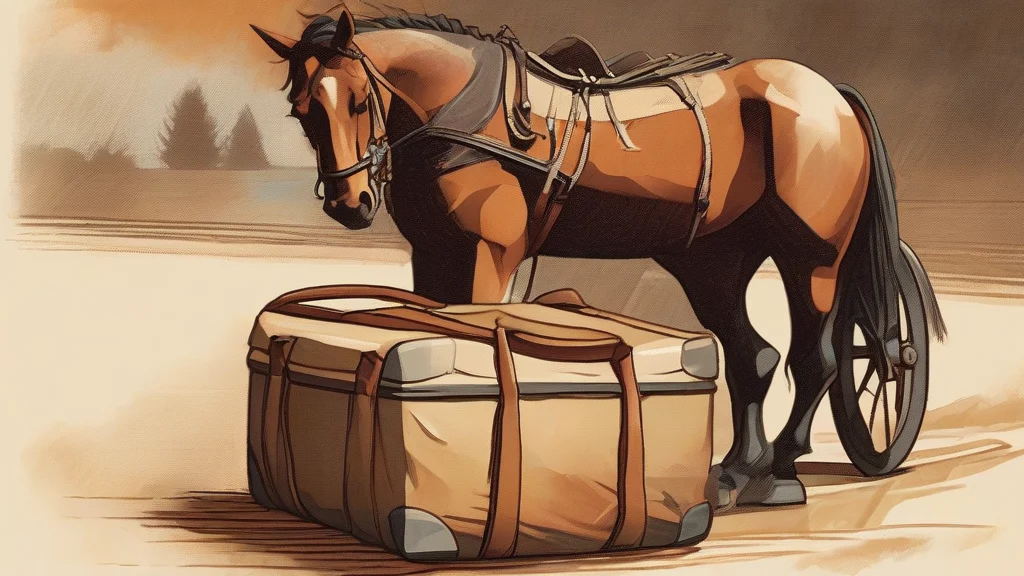
A carryall is a large, capacious bag designed to hold a wide variety of items — clothing, groceries, books, work gear — and the word emphasizes function over form: whatever needs transporting goes in it. Common in both British and American English, though more prevalent in American usage, it overlaps with near-synonyms such as 'tote' and 'holdall'. The name is transparently descriptive, formed from the verb phrase 'carry all', which also explains its older meaning: in eighteenth- and nineteenth-century North America, a carryall was a light four-wheeled horse-drawn carriage built to seat a whole family or group of passengers. That vehicular sense has largely faded, surviving mainly in historical writing, while the bag sense remains current, especially in retail and everyday speech. The word carries a practical, unpretentious connotation, suggesting usefulness rather than luxury, and remains a handy alternative when a simple 'bag' feels too vague.
A large bag or container used for carrying a variety of items.
"Her canvas carryall held a water bottle, a novel, and enough snacks for the whole train ride."
(Chiefly historical, North American) A light four-wheeled horse-drawn carriage seating several passengers.
"They rode the last mile of the journey in a battered carryall behind a tired plow horse."
This sense is now historical and appears almost exclusively in accounts of earlier centuries.
Regular plural formation; used for multiple bags or, historically, multiple carriages.
"The boutique displayed a row of leather carryalls along the back wall."
Before it was a bag you sling over your shoulder, a 'carryall' was a horse-drawn carriage designed to carry everyone — literally, it carried all.
Reviewed by Deb Chak, Editor. AI-assisted content curated by RJS Tech Solutions LLP.
Etymology of carryall
Carryall was formed in English by compounding the verb 'carry' with the adverb 'all', making its origin transparently descriptive: something that carries everything. The compound first appeared in the early eighteenth century, when it named a light four-wheeled carriage capable of conveying several passengers at once — that is, one that could 'carry all'. The underlying verb 'carry' derives from Anglo-Norman French 'carier', ultimately from Late Latin 'carricare', meaning to load a wheeled vehicle, itself rooted in Latin 'carrus' (a cart). This same Latin root gives English a family of related words including 'carriage', 'cargo', 'chariot', and 'charge'. In later use, particularly in American English, the term shifted from vehicles to bags and containers, where its meaning remains today.
How carryall is actually used
In modern usage, 'carryall' most often refers to a roomy, casual bag and appears frequently in fashion and retail contexts. The carriage sense is now historical and largely confined to descriptions of nineteenth-century American life. The word has a slightly old-fashioned, practical connotation compared to trendier terms like 'tote'.
Easily confused with carryall
A holdall is essentially the British equivalent of a carryall — a large soft bag for luggage or personal items — while 'carryall' is the more common term in American English.
A carrycot is a portable bed for a baby, whereas a carryall is a general-purpose bag for carrying miscellaneous belongings.