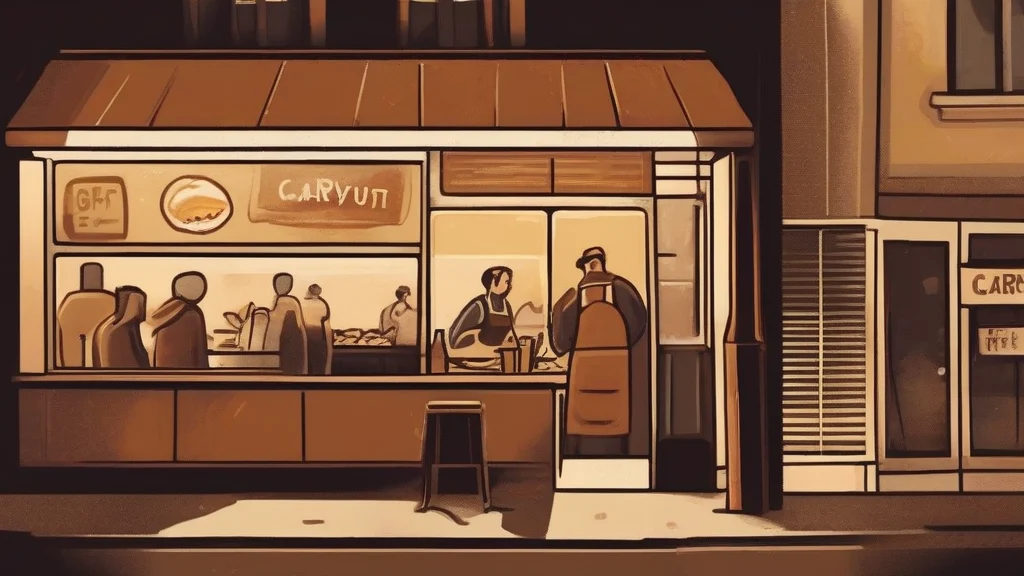
What does carryout mean?
A carryout is prepared food that a customer buys from a restaurant or shop with the intention of eating it somewhere else — at home, at work, or on the move — rather than dining in. The word functions as a noun ('We ordered carryout for dinner') and is especially common in the eastern and midwestern United States, where it coexists with the near-synonymous 'takeout'; British speakers overwhelmingly say 'takeaway'. In Scotland, 'a carry-out' carries a second, distinct meaning: alcoholic drink bought from a shop or pub to be consumed elsewhere. The term derives straightforwardly from the verb phrase 'to carry out', reflecting the simple act of carrying one's purchase out the door. Though casual in register, the word is firmly embedded in everyday speech in its home regions, and signs reading 'CARRYOUT' are a familiar fixture of neighbourhood shops, pizzerias, and Chinese restaurants there.
nounFood prepared by a restaurant or shop and taken away to be eaten elsewhere rather than consumed on the premises. In Scottish English, it can also refer to alcohol bought from an off-licence to be drunk elsewhere.
- (chiefly US) Prepared food that a customer buys to eat somewhere other than the restaurant or shop where it was made.
- (Scottish English) Alcoholic drink purchased from a shop or pub for consumption elsewhere; also, an occasion or session of drinking such purchases.
"We picked up some Chinese carryout on the way home."
"It was raining, so we decided to stay in with carryout instead of going to the restaurant."
"After the match they stopped at the off-licence for a carry-out before heading back to the flat."
Used when counting individual orders or purchases; the singular can function uncountably for the general concept of takeaway food.
"On busy Friday nights the kitchen turns out dozens of carryouts before closing."
In Scotland, ordering a 'carry-out' doesn't get you dinner — it gets you drinks to go.
Reviewed by Deb Chak, Editor. AI-assisted content curated by RJS Tech Solutions LLP.
Etymology of carryout
The word arises transparently from the English phrasal verb 'to carry out', formed within English itself rather than borrowed. It follows the common pattern by which phrasal verbs are solidified into nouns (compare 'takeout' and, in Britain, 'takeaway'). The underlying verb 'carry' traces back through Anglo-Norman 'carier' to Late Latin 'carricare' (to load onto a cart), from Latin 'carrus' (cart), making it a distant relative of 'cart', 'cargo', 'charge', and 'carriage'. The compound as a noun for takeaway food became established regionally in American English, while in Scotland it developed its distinctive sense of drink bought to consume off the premises.
How carryout is actually used
Primarily informal American usage, concentrated in the Mid-Atlantic states (Maryland, Pennsylvania) and parts of the Midwest, where 'carryout' competes with 'takeout'. In British English generally 'takeaway' is standard instead. The Scottish sense relating to alcohol is well established locally but may puzzle speakers elsewhere.
Easily confused with carryout
The two-word verb phrase 'carry out' means to perform or complete a task, while the one-word noun 'carryout' refers to food bought to eat elsewhere.
'Takeout' and 'carryout' mean essentially the same thing in American English, but 'carryout' is regional (East Coast/Midwest) while 'takeout' is used nationwide.