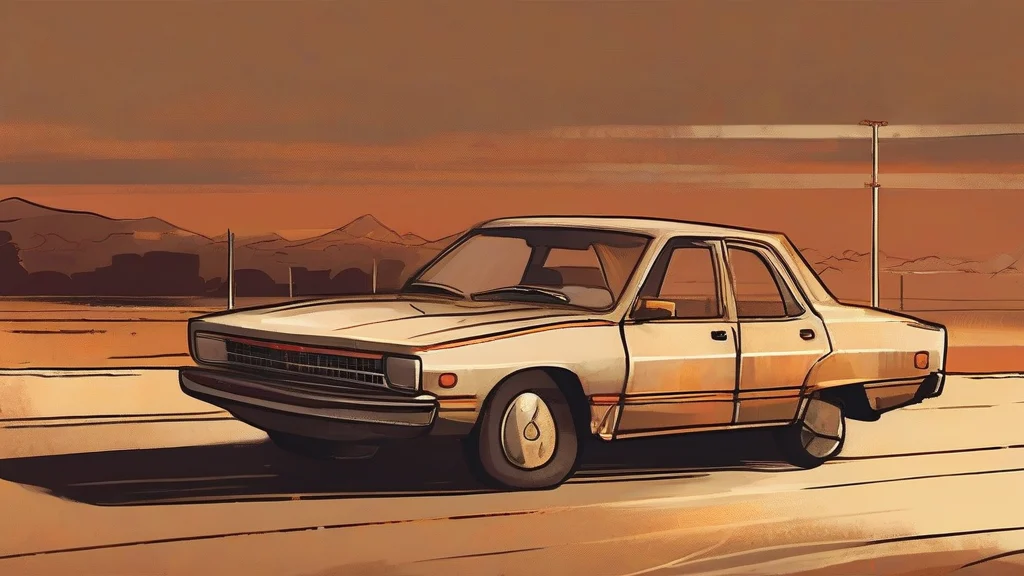
What does car mean?
A car is a road vehicle designed primarily for carrying a small number of people, typically seating one to five passengers and propelled by an internal combustion engine or electric motor. It has become one of the most consequential inventions of the modern era, reshaping cities, economies, and daily life by offering personal mobility on demand. In everyday usage, the word is neutral and universal: people speak of driving, parking, buying, renting, or repairing cars without any special connotation, though the word can also refer more narrowly to specific types such as sedans, hatchbacks, or sports cars. Beyond road vehicles, 'car' extends to rail transport — a dining car, sleeping car, or boxcar — and even to the cabin of an elevator or cable car. The term derives ultimately from the Latin carrus, a wheeled vehicle of Celtic origin, linking today's automobiles etymologically to the chariots and carts of antiquity.
A four-wheeled motor vehicle used for transporting passengers, typically seating up to five people.
"They bought a new car with better fuel efficiency."
In British English the fuller term 'motorcar' exists but is largely historical; 'car' is standard everywhere.
A separate section of a train or other conveyance for passengers or freight, such as a dining car or boxcar.
"We reserved seats in the observation car of the train."
The compartment in which passengers ride in an elevator, cable car, or similar conveyance.
"The elevator's car was out of service, so we took the stairs."
Regular plural; used identically in both British and American English.
"The dealership had dozens of cars lined up along the lot."
The word 'car' traces back to Latin 'carrus' — a Celtic-style war chariot the Romans borrowed, making today's sedan a distant descendant of ancient battle wagons.
Reviewed by Deb Chak, Editor. AI-assisted content curated by RJS Tech Solutions LLP.
Etymology of car
The word car comes from the Latin carrus, a four-wheeled baggage or transport wagon that the Romans adopted from Celtic-speaking peoples of Gaul. It passed through Old North French as carre before entering Middle English around the late medieval period, originally denoting a wheeled cart or wagon. When horseless carriages appeared in the late nineteenth century, the shortened form 'car' naturally attached itself to the new self-propelled vehicles. Cognates and relatives include chariot, carriage, cargo, and charge — the latter two deriving from the related Latin verb carricare, meaning to load onto a cart.
Related word forms
How car is actually used
'Car' is neutral in register and universally understood across English-speaking regions. In British English, 'motorcar' was once the more formal term but now sounds dated; American English uses 'car' as the everyday default, while British speakers may also say 'motor' informally.
Easily confused with car
A cart is an open, usually two-wheeled vehicle drawn by animals or pushed by hand, whereas a car is a self-powered motor vehicle.