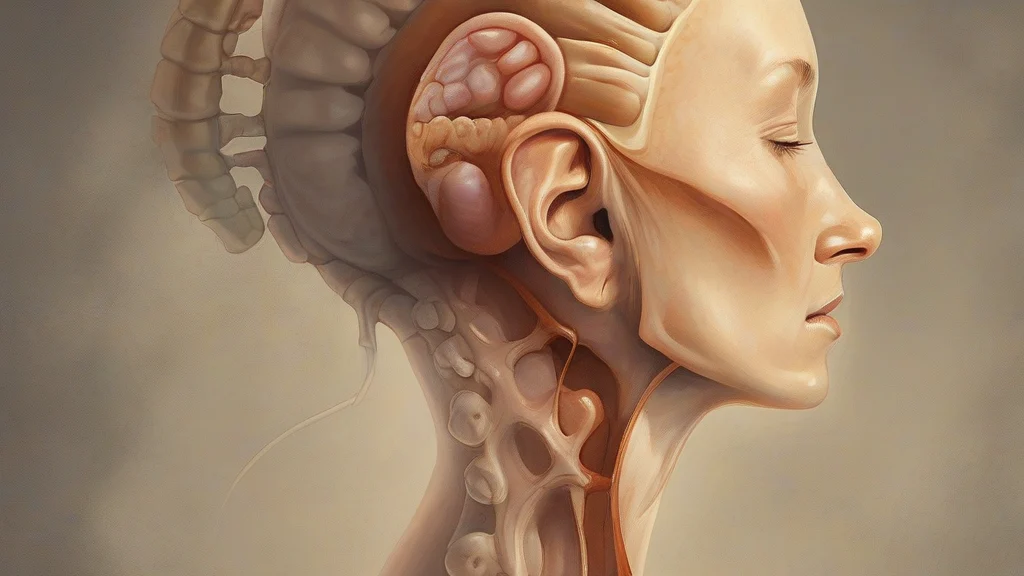
What does cartilage mean?
Cartilage is the firm yet flexible connective tissue that gives shape and cushioning to parts of the body such as the joints, ears, nose, rib cage, and the discs between the vertebrae. Tougher than flesh but softer and more pliable than bone, it allows smooth movement at joints and absorbs shock during walking, running, and lifting. Because cartilage has no blood supply of its own, it receives nourishment indirectly and repairs itself very slowly, which is why injuries like torn knee cartilage can be stubborn and are a familiar concern for athletes. The word also appears informally for the chewy gristle found on meat or in some traditional dishes. Derived from Latin, the term entered English around the sixteenth century, and its adjective form is cartilaginous. It is a staple of anatomy, medicine, and sports reporting alike.
nounCartilage is a firm, flexible connective tissue found in the bodies of humans and other vertebrates, especially at joints, in the ear, nose, and rib cage, and between spinal vertebrae. It cushions bones and structural surfaces but, lacking its own blood supply, heals slowly when damaged.
- The tough, elastic connective tissue that forms parts of the skeleton, such as joint surfaces, the ear, nose, and intervertebral discs.
- Informally, animal cartilage eaten as food, especially in certain cuisines where chewy gristly texture is prized.
"The surgeon warned that years of running had worn away the cartilage in his knee."
"The MRI revealed a small tear in the cartilage of her left knee."
"In many East Asian dishes, simmered fish cartilage adds a pleasantly crunchy texture to soups."
Rare and largely restricted to older or specialist anatomical writing, where it refers to individual discrete pieces of cartilage; standard modern usage treats cartilage as uncountable.
"Early anatomists described the cartilages of the larynx in meticulous detail."
Sharks have no bones at all — their entire skeleton is made of cartilage.
Reviewed by Deb Chak, Editor. AI-assisted content curated by RJS Tech Solutions LLP.
Etymology of cartilage
Cartilage derives from the Latin word 'cartilago', meaning gristle or cartilage, whose further origin is uncertain. The term passed into English via Old French 'cartilage' and was established in English by the early modern period, appearing in anatomical writing by the sixteenth century. Its direct English derivative is the adjective 'cartilaginous', coined from the same Latin root.
Related word forms
How cartilage is actually used
Cartilage is an uncountable noun in most anatomical usage, though 'cartilages' occasionally appears in older medical texts referring to distinct pieces of cartilage. The register is neutral-to-technical; everyday speakers often say 'torn' or 'worn' cartilage when discussing sports injuries.
Easily confused with cartilage
A cartridge is a container holding ammunition, ink, or other consumable material, whereas cartilage is the rubbery connective tissue in the body.