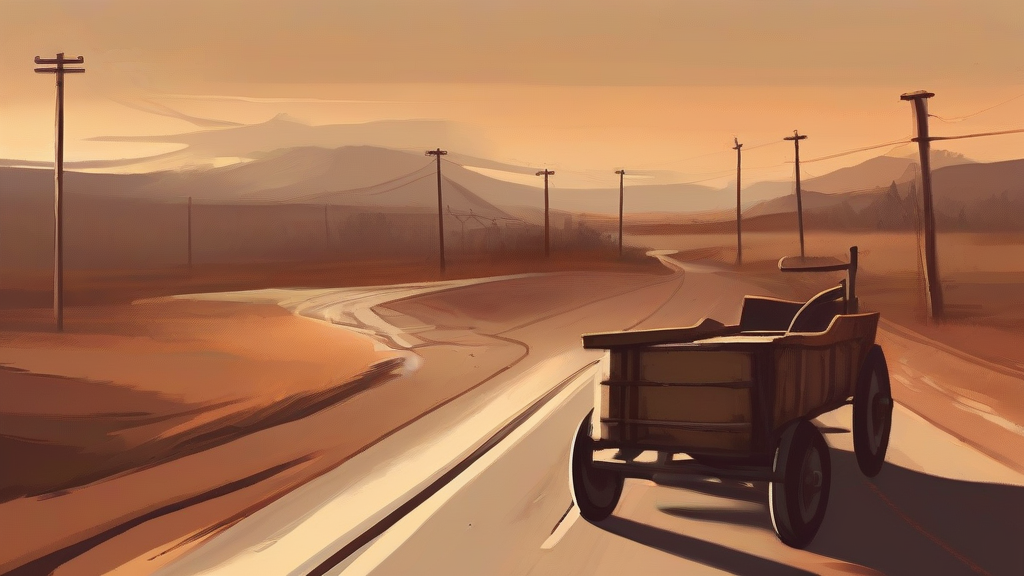
What does cartroad mean?
A cartroad is a simple, often unpaved road or track built for — or habitually used by — carts and other slow, heavy wheeled vehicles. The word is straightforwardly descriptive: a road whose character is defined by cart traffic. While it can appear in older British and American texts, it is especially characteristic of South Asian English, particularly in India and Bangladesh, where rural infrastructure is frequently described this way and where bullock carts remain part of everyday transport. A cartroad is typically narrow, earthen, and unmetalled, winding through farmland or linking villages to markets, so the word carries rustic connotations of countryside life rather than modern highways. In contemporary Western usage, terms like 'cart track,' 'track,' or 'dirt road' have largely displaced it, giving 'cartroad' a slightly old-fashioned flavor outside South Asia. It remains useful precisely because no other single word captures both the function of the road and the kind of traffic it serves.
nounA road or track along which carts travel; a rough road suitable for wheeled vehicles such as carts.
- A rough rural road or track used by carts and other wheeled vehicles.
"The villagers carried their harvest down the narrow cartroad to the market town."
"The monsoon rains had turned the cartroad into a ribbon of deep mud."
"A narrow cartroad wound through the paddy fields toward the village."
Regular plural formation; used mainly in descriptions of rural road networks, especially in South Asia.
"Several unpaved cartroads connect the outlying farms to the main highway."
In much of South Asia, the humble 'cartroad' is still an official term — many rural roads are literally named for the ox-carts they were built to carry.
Reviewed by Deb Chak, Editor. AI-assisted content curated by RJS Tech Solutions LLP.
Etymology of cartroad
Cartroad is a compound of 'cart' and 'road,' formed transparently within English. The word 'cart' derives from Old Norse 'kartr,' borrowed into Middle English during the Viking Age, while 'road' comes from Old English 'rād,' originally meaning a riding expedition or journey, from the same root as the verb 'ride.' The compound likely arose when such roads were a routine feature of rural life, and it survives most vigorously today in South Asian English, where colonial-era terminology persisted into official usage.
How cartroad is actually used
The term is somewhat dated or regional in American and British English, where 'cart track' or 'dirt road' is more typical. It remains in active, standard use in South Asian English, particularly in India and Bangladesh, where it appears in official and everyday descriptions of rural infrastructure.
Easily confused with cartroad
A 'cartroad' is the path a cart travels on, while a 'cartload' is the amount that a cart can carry.