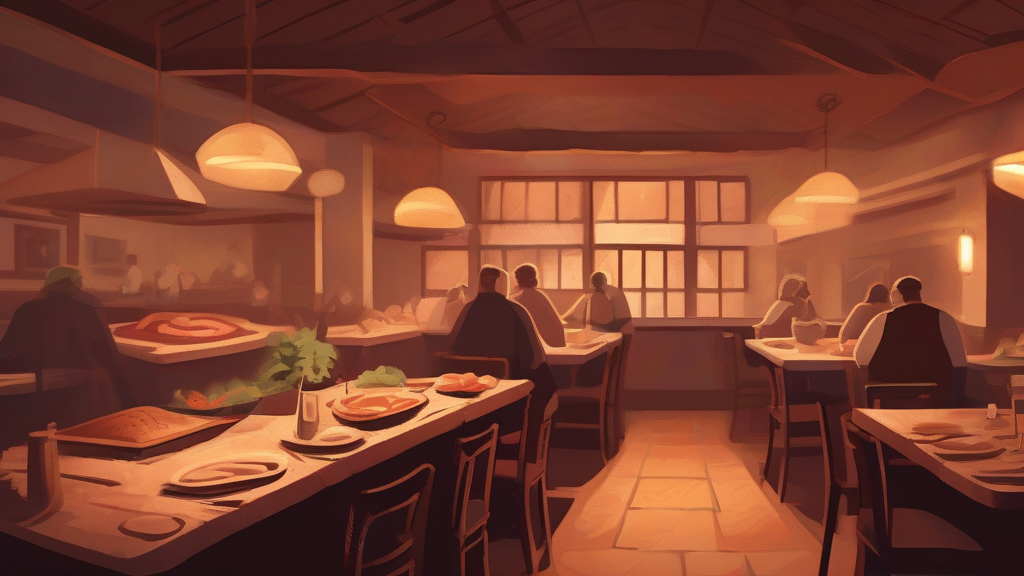
What does carvery mean?
A carvery is a restaurant, or a dedicated section within one, whose central offering is roasted meat carved fresh to order, usually accompanied by vegetables, potatoes, gravy, and other traditional trimmings. The term is used both for the establishment itself and for the counter at which the meat is sliced and served. Strongly associated with British and Irish dining culture, the carvery is a fixture of pubs and hotels, where the 'Sunday carvery' — a leisurely weekend meal centered on roast beef, turkey, or lamb — has become something of an institution. The word carries connotations of hearty, unpretentious food and generous portions rather than haute cuisine. Derived from the verb 'carve' with the suffix '-ery', it denotes a place associated with that action, much like 'bakery' or 'brewery'. While familiar throughout Britain, Ireland, and Australia, the term may need explanation for North American readers, who would more likely describe such a setup simply as a carving station or buffet.
nounA restaurant, or a section of one, that specializes in roasted meats which are carved to order for customers, typically served with vegetables, gravy, and accompaniments. It can also refer to the counter or buffet itself at which the meat is carved.
- A restaurant or dining establishment specializing in roasted meats carved to order.
- The counter or service area in a restaurant or pub where roast meat is carved and served.
"We booked a table at the pub's Sunday carvery, where the chef carved succulent slices of roast beef straight from the joint."
"The hotel's carvery offers a choice of roast turkey, beef, or glazed ham with all the trimmings."
"Queues form early at the carvery on Sundays, when families come for the traditional roast."
The standard plural follows regular noun inflection; it typically appears when comparing or counting multiple such establishments.
"The town has several carveries, each claiming to serve the best roast beef in the county."
The word 'carvery' is barely two centuries of British pub culture old — proof that sometimes the best way to sell dinner is to make the carving part of the show.
Reviewed by Deb Chak, Editor. AI-assisted content curated by RJS Tech Solutions LLP.
Etymology of carvery
Carvery is formed from the verb 'carve', itself derived from Old Northern French 'carver' (a variant of Old French 'kerver'), which entered English after the Norman Conquest. The suffix '-ery', from Old French '-erie', denotes a place associated with an activity, as in 'bakery' or 'brewery'. The compound arose in British English, likely in the 19th or early 20th century, as establishments specializing in carved roast meats became popular. It shares its ultimate root with related words such as 'carver' and 'carving'.
How carvery is actually used
Chiefly British and Irish English; the term is well understood in Australia and parts of Europe but may sound unfamiliar or require explanation in North America, where similar concepts are usually called 'roast' meals or buffet-style carving stations. The register is informal-to-neutral and strongly associated with pubs, hotels, and casual family dining rather than fine restaurants.