What does casque mean?
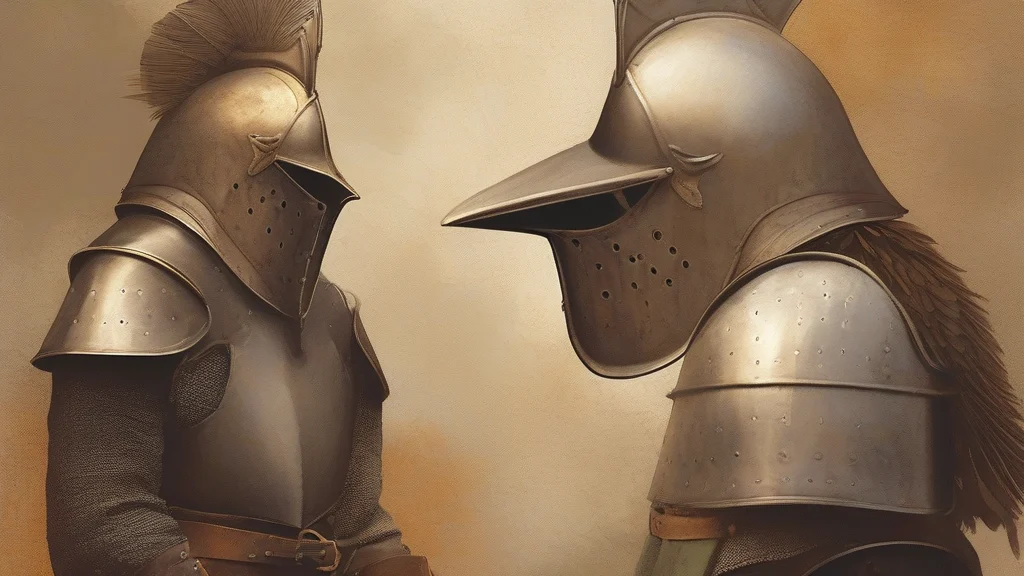
A casque is a helmet, most specifically the streamlined steel headpiece associated with medieval European knights, though the word can denote any close-fitting protective head covering. In modern usage it survives chiefly in two settings: historical and literary descriptions of armor, and ornithology, where it names the hard, bony or keratinous crest that crowns the skulls of birds such as hornbills, cassowaries, and some turacos. This double life gives the word an unusual range — evoking both chivalric romance and natural history in a single term. Derived from French casque, meaning 'helmet,' it entered English during the early modern period as interest in heraldry and medieval warfare flourished. Writers reach for it when 'helmet' feels too plain or generic, lending prose an air of antiquity or precision. Its plural is casques, and its adjectival derivative, casqued, describes anything crowned or covered with such a structure.
nounA helmet, especially the close-fitting steel headpiece worn by medieval knights; also, in ornithology, the hard bony crest or protuberance on the head of certain birds such as cassowaries and hornbills.
- A helmet, especially the close-fitting armored headpiece worn by medieval knights.
- In ornithology, the hard bony or horny protuberance on the head of certain birds such as hornbills and cassowaries.
"The knight lifted his casque to reveal a face streaked with dust."
"The museum's centerpiece was a gleaming casque recovered from a fifteenth-century battlefield."
"The male cassowary sports a tall keratinous casque atop its skull, whose exact function is still debated by scientists."
Regular plural; used for both helmets and bird crests.
"Rows of casques hung along the armory wall."
The same word that named a knight's battle helmet now names the bony crown atop a cassowary's head — nature borrowed armor from the Middle Ages.
Reviewed by Deb Chak, Editor. AI-assisted content curated by RJS Tech Solutions LLP.
Etymology of casque
Casque comes directly from the French casque, meaning 'helmet,' which English adopted around the early seventeenth century alongside a broader fascination with chivalric arms and armor. The French word itself likely derives through Old French from Spanish casco, originally meaning 'skull' or 'potsherd,' ultimately tracing to a Latin root shared with words such as cask and casket. Its later application to the crests of birds reflects nineteenth- and twentieth-century scientific usage, which favored precise Latinate and Romance terms for anatomical features.
Related word forms
How casque is actually used
Literary and technical in register. The military sense appears mainly in historical writing about medieval and Renaissance armor, while the zoological sense occurs almost exclusively in ornithology.
Easily confused with casque
A cask is a large wooden barrel for storing liquids, while a casque is a helmet or bird's head crest.
A mask covers the face for disguise or protection, whereas a casque is a rigid protective headpiece or a bird's cranial ridge.