What does cassowary mean?
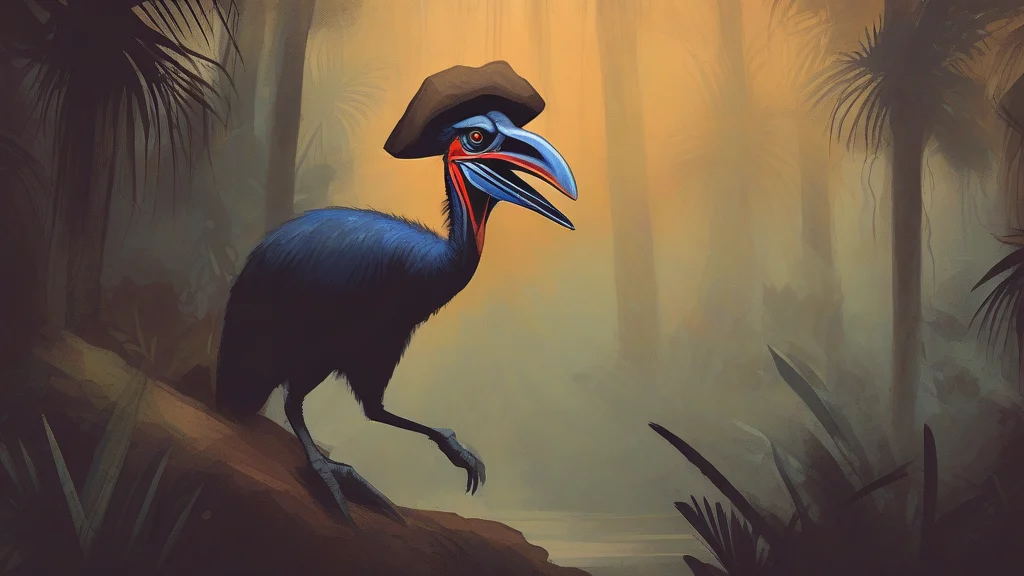
The cassowary is a large, flightless bird belonging to the genus Casuarius, native to the tropical rainforests of New Guinea, nearby islands, and northeastern Australia. It is instantly recognisable by its glossy black plumage, vividly coloured blue and red neck skin, and the hard, helmet-like casque atop its head. Standing up to two metres tall, the southern cassowary is among the heaviest birds in its range and is famed for the long, sharp claw on each foot, which has given it a fearsome reputation as potentially dangerous to humans when cornered or defending chicks. Despite this notoriety, it is generally reclusive and plays an essential ecological role as a seed disperser for dozens of rainforest plant species, some of which depend almost entirely on it. The name derives from Malay kasuari, entering English in the early seventeenth century through Dutch and Portuguese accounts of the region's fauna.
nounA large, flightless bird native to the rainforests of New Guinea and northeastern Australia, with a distinctive bony casque on its head, a brightly coloured neck, and a dagger-like claw on each foot. It is often cited as one of the most dangerous birds to humans.
- Any of several species of large flightless birds of the genus Casuarius, found in New Guinea and northeastern Australia.
"The ranger warned hikers that a cassowary had been sighted near the trailhead."
"The southern cassowary plays a vital role in dispersing the seeds of rainforest trees."
"Zookeepers feed the cassowary a diet of fruit, insects, and small animals."
Standard plural formed by changing '-y' to '-ies'; used both for multiple individuals and generically for the group.
"Wildlife rangers monitor cassowaries throughout the Daintree rainforest."
The cassowary's claw can grow up to 12 centimetres long — earning it a reputation as the world's most dangerous bird.
Reviewed by Deb Chak, Editor. AI-assisted content curated by RJS Tech Solutions LLP.
Etymology of cassowary
The word 'cassowary' entered English in the early seventeenth century, borrowed via Dutch or Portuguese travellers' accounts from Malay kasuari, which itself ultimately traces back to a Papuan source language of New Guinea. It belongs to a small group of animal names absorbed into European languages during early contact with the Malay Archipelago. Because of its Papuan ultimate origin, it has no true Latin- or Greek-rooted cognates in English.
How cassowary is actually used
The word is used almost exclusively in zoological, ornithological, and nature-documentary contexts; it carries no figurative or idiomatic use in general English.
Easily confused with cassowary
A cassowary is a large flightless bird, while cassava is a starchy tropical root vegetable used for food.