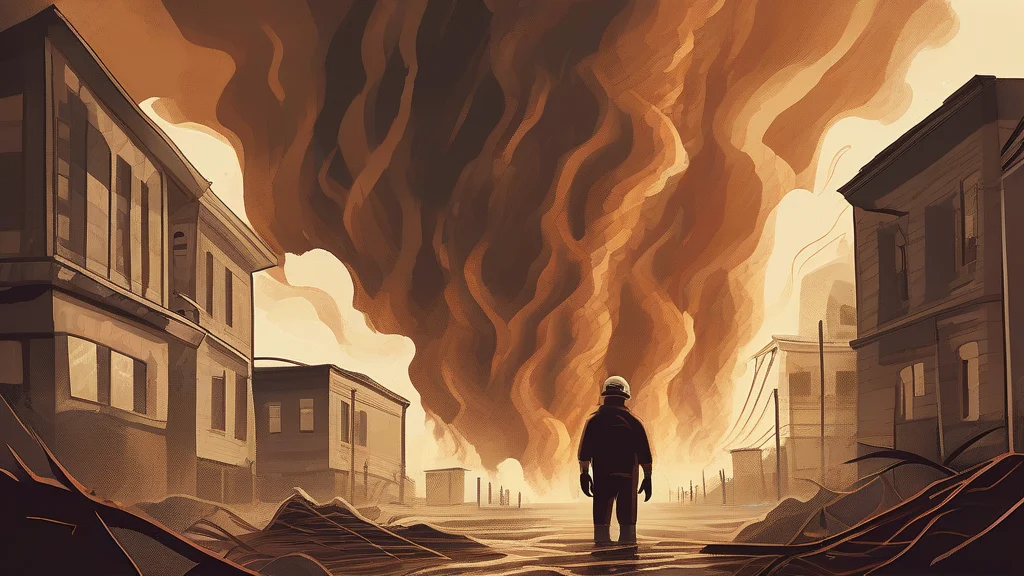
What does cataclysmic mean?
Cataclysmic is an adjective describing events of overwhelming, often destructive scale. Its original sense referred to cataclysms — vast natural disasters such as floods, earthquakes, and volcanic eruptions — and this literal meaning persists in geology and earth science. Today, however, the word is used far more often figuratively, to characterize wars, economic collapses, political revolutions, or personal failures whose effects are sudden and sweeping: a cataclysmic defeat, cataclysmic changes, cataclysmic consequences. The word carries strong connotations of finality and irreversibility; something cataclysmic does not merely go wrong but transforms its surroundings dramatically, usually for the worse. It sits at the formal end of everyday vocabulary, appearing frequently in journalism, history, and scientific writing, and is more emphatic than near-synonyms like disastrous or calamitous. Derived from Greek via Latin, it retains a vivid etymological image of being washed away by a great flood.
Relating to or characteristic of a cataclysm — a violent, large-scale natural disaster.
"The fossil record preserves signs of cataclysmic flooding in the region's distant past."
The literal sense is most common in geology, climatology, and discussions of natural disasters.
(Figurative) Involving or causing sudden, widespread, and momentous destruction or upheaval.
"Losing the contract proved cataclysmic for the small firm, which closed within months."
This is now the dominant sense in general usage; typically applied to negative, transformative events.
Cataclysmic literally means 'washed down' — the ancient Greeks used it for Noah-style floods before it came to describe any earth-shattering upheaval.
Reviewed by Deb Chak, Editor. AI-assisted content curated by RJS Tech Solutions LLP.
Etymology of cataclysmic
Cataclysmic derives from the Greek 'kataklysmikos', formed on 'kataklysmos' meaning 'deluge' or 'flood', from 'kataklyzein', 'to wash over' or 'wash down' ('kata-' = down, 'klyzein' = to wash). The noun 'cataclysm' entered English in the early 17th century, initially referring specifically to the biblical Flood and other great deluges, and the adjective followed later. As the noun broadened to cover any violent natural upheaval and then figurative disasters, cataclysmic broadened with it. It shares its Greek root 'klyzein' with related watery vocabulary, though its closest English relative remains the noun cataclysm itself.
Related word forms
How cataclysmic is actually used
Formal-to-neutral register, common in journalism, science writing, and historical analysis. The literal geological sense has largely given way to figurative use for dramatic, often negative upheavals. Stronger and more dramatic in tone than 'disastrous'.
Easily confused with cataclysmic
Cataclysmic originally denotes a deluge or flood-like upheaval (from Greek kataklysmos), while catastrophic comes from a Greek word for an overturning or downfall — in modern use both mean disastrously destructive, but catastrophic is far more common in everyday speech.