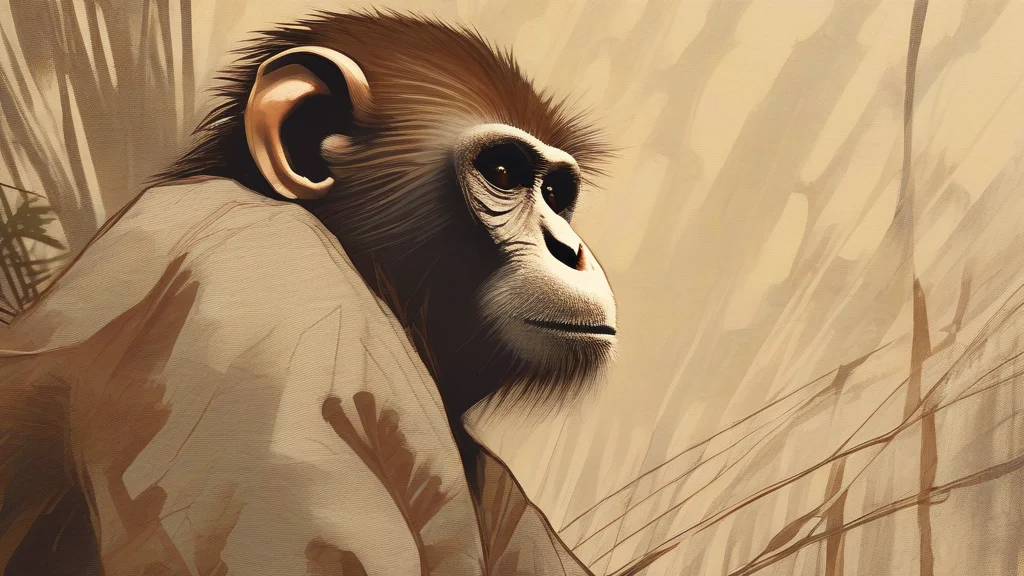
What does catarrhine mean?
A catarrhine is any primate belonging to the group Catarrhini, which includes all Old World monkeys, apes, and humans. The name derives from Greek roots meaning 'down' and 'nose', reflecting the defining anatomical trait shared by these animals: narrow nostrils that face downward rather than to the sides. This feature distinguishes them from platyrrhines — the New World monkeys of Central and South America, whose nostrils are broad and flaring. Beyond nasal shape, catarrhines share other traits such as generally larger body size, greater encephalization, and, in most species, the absence of a prehensile tail. The word appears chiefly in scientific writing on primatology and physical anthropology, where it serves as a precise taxonomic label. Though rarely used outside academic circles, it offers a striking example of how anatomy shapes classification, grouping humanity alongside its closest evolutionary relatives under a single descriptive term rooted in ancient Greek.
An Old World monkey, ape, or human; a primate of the infraorder Catarrhini, having narrow, downward-pointing nostrils.
"Baboons, macaques, and gibbons are all catarrhines."
Usually used in plural form 'catarrhines' when referring to members of the group collectively.
Of or relating to the catarrhine primates; having the narrow, downward-facing nostrils characteristic of this group.
"The catarrine dental formula differs noticeably from that of New World monkeys."
Typically precedes nouns such as 'primate', 'monkey', or 'nostril' in scientific descriptions.
Standard plural, used when referring to multiple individual catarrhine primates.
"Early catarrhines diversified across Africa during the Miocene."
The word 'catarrhine' literally means 'down-nosed' in Greek — it's the technical term that groups your nose together with those of gorillas and baboons, while excluding the monkeys of the Americas.
Reviewed by Deb Chak, Editor. AI-assisted content curated by RJS Tech Solutions LLP.
Etymology of catarrhine
'Catarrhine' comes from the Greek words 'kata', meaning 'down', and 'rhis' (genitive 'rhinos'), meaning 'nose', so it literally translates as 'down-nosed'. The term was adopted into scientific Latin and English nomenclature in the nineteenth century as naturalists formalized primate classification. It shares its root element with medical vocabulary such as 'rhinoceros' ('nose-horned') and 'catarrh', both drawing on the same Greek word for the nose.
How catarrhine is actually used
Primarily used in scientific, academic, and technical contexts — physical anthropology, primatology, and zoology. Rarely encountered in everyday conversation. When used as an adjective, it typically appears before nouns such as 'monkey', 'primate', or 'nostril'. The plural 'catarrhines' is standard when referring to multiple individuals of this group.
Easily confused with catarrhine
Platyrrhine refers to New World monkeys (such as spider and capuchin monkeys) with broad, flat, outward-facing nostrils, whereas catarrhine refers to Old World monkeys, apes, and humans with narrow, downward-facing nostrils.