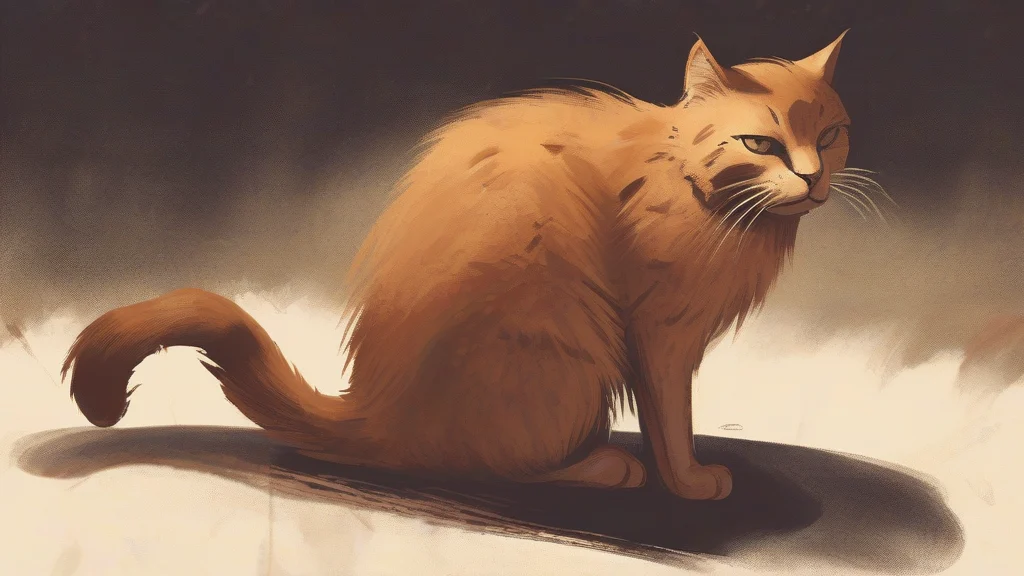
What does cat mean?
The cat is a small, agile carnivorous mammal that has lived alongside humans for thousands of years, valued both as a companion and as a hunter of rodents. Scientifically the domestic cat belongs to the family Felidae, which also includes lions, tigers, and other 'big cats' — a term English borrows for these larger relatives. Beyond its literal use, 'cat' carries rich figurative weight: it appears in idioms like 'let the cat out of the bag' and 'raining cats and dogs', describes stealthy movement in phrases such as 'cat burglar', and in mid-twentieth-century jazz slang referred affectionately to a man or musician. The word's flexibility makes it useful across registers, from children's stories to technical zoological writing. Its enduring cultural presence — from ancient Egyptian veneration to modern internet celebrity — has made the cat one of the most familiar and beloved animals in the English-speaking world.
A small domesticated feline mammal with soft fur and retractile claws, kept as a pet or used to catch mice and rats.
"She adopted two cats from the shelter last spring."
Also extended to wild felines: 'big cats' include lions, tigers, and leopards.
In jazz and related slang, a man or fellow, often implying style or hipness.
"That cat can really play the trumpet."
Dated but culturally recognized; associated with mid-20th-century jazz culture.
(Of an animal, especially a cat, informally in North American usage) to vomit.
"I think the cat ate too fast and then cat-ed all over the rug."
Chiefly informal American usage; rare in British English.
Regular plural formed with -s. The archaic irregular plural 'kine' does not apply here.
"Cats are known for their independence and curiosity."
Ancient Egyptians shaved their eyebrows in mourning when a family cat died — and the word itself may trace back to an African word for the same creature.
Reviewed by Deb Chak, Editor. AI-assisted content curated by RJS Tech Solutions LLP.
Etymology of cat
The word 'cat' comes from Old English 'catt', which likely derives from Late Latin 'cattus', the term adopted into Germanic languages during the early medieval period. Latin 'cattus' itself probably traces back through Greek to an Afroasiatic source, possibly the Nubian word 'kadīs' for a wild cat. Cognates appear across Europe, including Dutch 'kat', German 'Katze', French 'chat', and Spanish 'gato', reflecting how widely the domesticated animal spread alongside the vocabulary naming it.
Related word forms
How cat is actually used
'Cat' is neutral and universal across registers. In jazz and beat slang, calling a person 'a cat' is dated but recognizable ('hep cat'). The plural is simply 'cats'; the collective noun for a group is a 'clowder' (rare) or more commonly 'group'.
Easily confused with cat
A catalog is a systematic list of items; 'cat' is the animal and only appears within the longer word by spelling coincidence.
A cot is a small bed or collapsible sleeping frame, while a cat is the furry feline animal.