What does causeway mean?
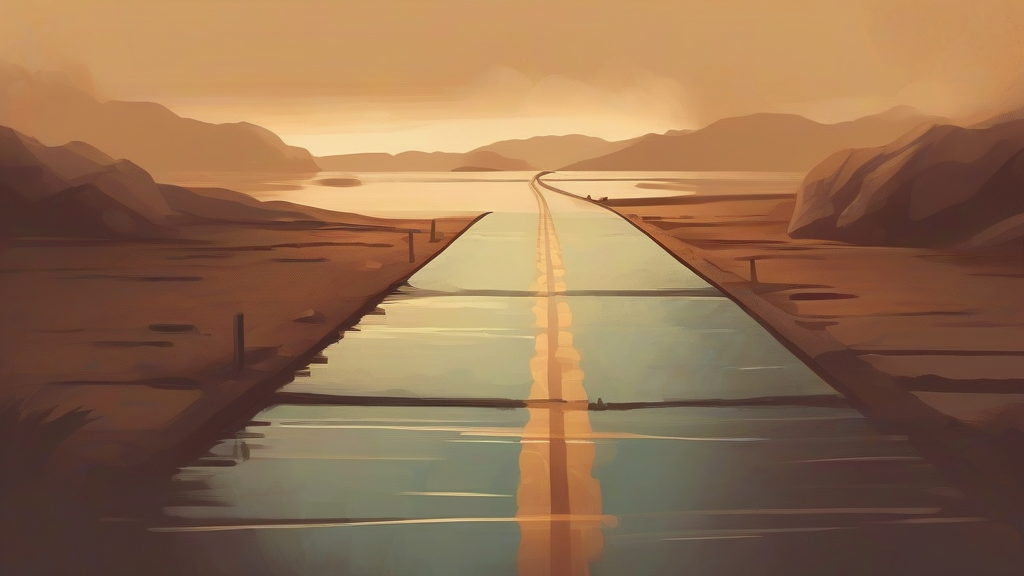
A causeway is a raised road or track, usually constructed from earth, stone, or concrete, built so that people and vehicles can cross ground that would otherwise be impassable — marshes, mudflats, rivers, or tidal waters. Some famous causeways, such as the one linking Mont-Saint-Michel in France to the mainland, are submerged at high tide and usable only at low tide, giving them a dramatic, almost magical quality. In engineering contexts, a causeway may be a substantial embankment carrying a railway or highway across a floodplain or shallow bay. The word carries no strong connotation of formality; it appears equally in travel writing, history, and technical description. Its enduring usefulness lies in naming a specific kind of structure: a firm path imposed on soft or watery terrain.
nounA raised road or track, typically of stone or earth, built across low or wet ground such as a marsh, tidal flat, or shallow water.
- A raised road or track across wet, low-lying, or flooded ground, especially one connecting an island to the mainland.
- (Less common) The paved or elevated roadway itself in general use.
"At low tide we walked the stone causeway that connects the island to the mainland."
"The only link to the village is a narrow causeway that disappears under water at high tide."
"Visitors stroll along the ancient causeway, marveling at stones laid down centuries ago."
Regular plural; simply add -s.
"The region's ancient causeways were built by monks to reach remote islands."
The word "causeway" hides a piece of ancient road engineering inside it — it ultimately traces back to Latin calx, the same root that gives us "calcium" and "chalk," because early causeways were literally paved roads made of packed limestone.
Reviewed by Deb Chak, Editor. AI-assisted content curated by RJS Tech Solutions LLP.
Etymology of causeway
Causeway derives from Middle English “causey” (a paved road), borrowed from Anglo-Norman French “caucie”, itself from medieval Latin “via calciata”, meaning a road trodden or paved with limestone. The second element was later reinterpreted as English “way”, giving the modern compound form. The ultimate root, Latin “calx” (lime, limestone), also yields words such as “calcium” and “chalk”, making these distant relatives of causeway.
How causeway is actually used
Neutral register; used in both everyday and technical (civil engineering, geography) contexts. Often appears in descriptions of coastal or marshland landscapes.
Easily confused with causeway
"Cause" means a reason or motive for something, while "causeway" is a raised road over wet ground — they share a spelling beginning but entirely different meanings and histories.