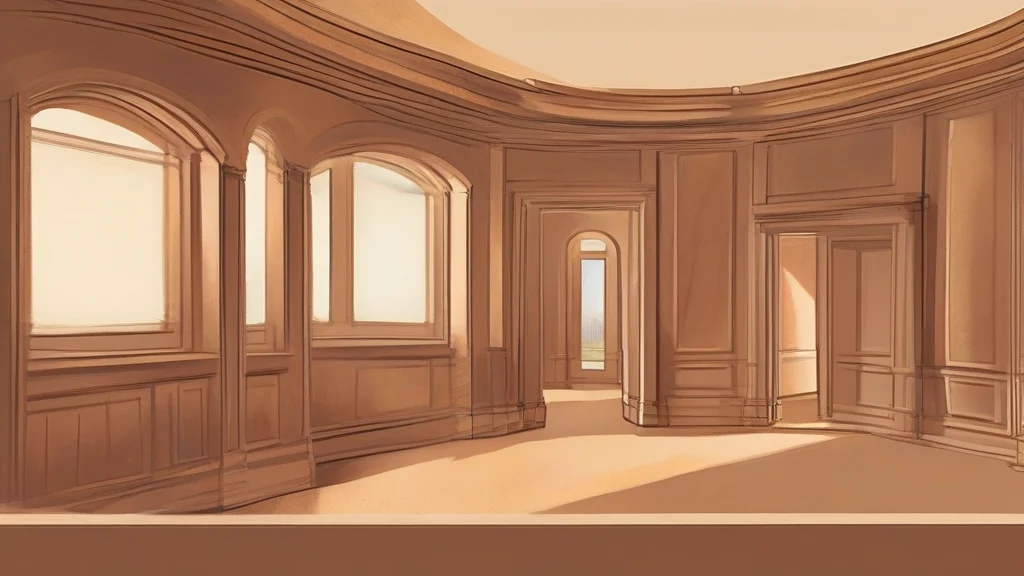
What does cavetto mean?
A cavetto is a concave moulding in classical architecture whose profile forms a quarter of a circle. It is most characteristically employed as the crowning element of a cornice, easing the visual and structural transition between a wall and its projecting roof or eaves; in Egyptian architecture, enormous cavetto cornices bearing carved decoration were a defining feature of temple facades. The word comes from Italian, meaning literally 'a little hollow', and reflects the curve's scooped appearance. In furniture and joinery, smaller-scale cavettos soften the junction between a top and its supporting case. The moulding's practical value lies partly in weathering — a well-formed cavetto throws rainwater away from the wall face — but its enduring appeal is aesthetic: by catching shadow along its inward sweep, it lends cornices a sense of lightness and lift. The term belongs chiefly to the vocabulary of architects, conservators, and historians of design rather than everyday speech.
nounA concave architectural moulding whose profile is a quarter of a circle, typically used at the top of a wall or cornice where it meets a projecting roof or eave.
- A concave quarter-circle moulding, especially one forming the crowning member of a cornice or wall.
"The eaves of the Tuscan farmhouse were finished with a graceful cavetto that threw the rainwater clear of the walls."
"The temple's entablature terminated in a broad cavetto that softened the transition to the overhanging roof."
"Egyptian temples often featured a massive cavetto cornice crowned with the winged sun disk."
The regular English plural 'cavettos' is standard; 'cavetti' occasionally appears in specialist writing influenced by Italian.
"The portico's cavettos were recut during the nineteenth-century restoration."
The gentle inward curve of a cavetto is the reason so many classical cornices seem to 'lift' the roof off the building — it's an illusion created by shadow.
Reviewed by Deb Chak, Editor. AI-assisted content curated by RJS Tech Solutions LLP.
Etymology of cavetto
Cavetto derives from Italian, where cavetto is the diminutive of cavo ('hollow'), ultimately from Latin cavus ('hollow'). It entered English usage in the seventeenth century as architects studying classical orders adopted Italian terminology for moulding profiles. The same Latin root yields English words such as cave, cavernous, concave, and excavate.
How cavetto is actually used
Strictly a term of architecture and the decorative arts; rarely encountered outside discussions of classical design, furniture, and historic buildings.
Easily confused with cavetto
An ogee is an S-shaped double curve (convex above, concave below), whereas a cavetto is a simple concave quarter-circle.
A scotia is also a concave moulding but is deeper and used mainly at the base of columns, while the cavetto crowns the tops of walls and entablatures.