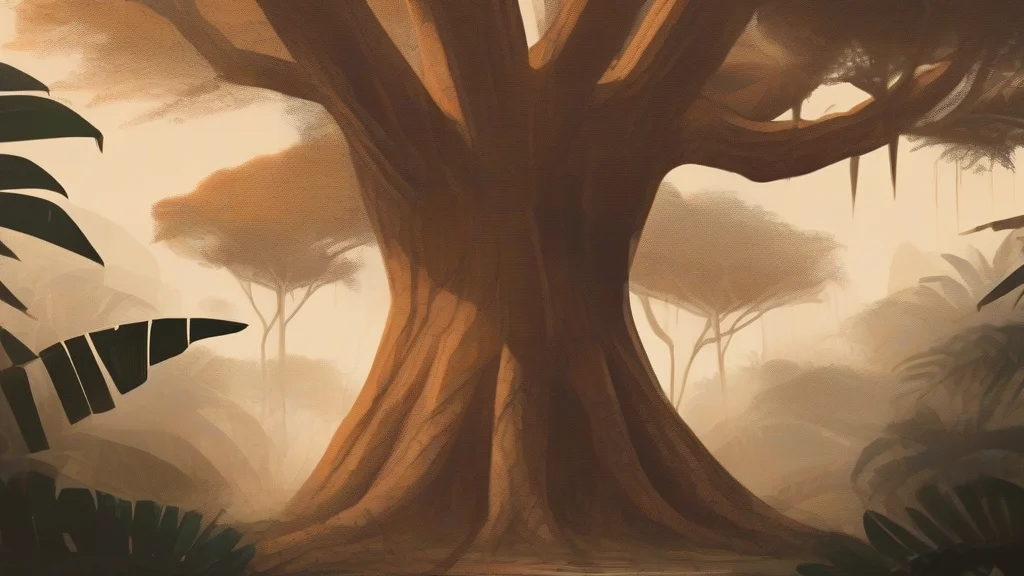
What does ceiba mean?
A ceiba is a very large tropical tree belonging to the genus Ceiba, best represented by Ceiba pentandra, the kapok or silk-cotton tree of Central America, South America, the Caribbean, and West Africa. Ceibas are among the most imposing trees on earth: they can reach heights well above fifty metres, and their trunks are often flanked by enormous plank-like buttresses that can stand several metres tall. The tree's seed pods contain kapok, a light, water-resistant fibre once widely used to stuff mattresses, cushions, and life jackets. Beyond botany, the ceiba holds deep cultural significance: it was sacred to the ancient Maya, who regarded it as the axis mundi — a world tree connecting the heavens, the earth, and the underworld — and it remains a national symbol of Guatemala and Puerto Rico. In English usage the word appears chiefly in scientific, travel, and cultural writing about the tropics.
nounA large tropical tree of the genus Ceiba, native to Central and South America and the Caribbean, notable for its immense buttressed trunk, tall straight growth, and the kapok fibre borne in its seed pods.
- A tall tropical tree of the genus Ceiba, especially Ceiba pentandra (the kapok or silk-cotton tree), known for its massive buttressed trunk and seed pods containing kapok fibre.
"The ancient ceiba towered over the Maya plaza, its buttresses rising higher than a house."
"A lone ceiba dominated the savanna, visible for miles across the flat grassland."
"Villagers gathered beneath the ceiba, whose spreading branches offered shade from the midday sun."
Regular English plural; used when referring to multiple trees or several species collectively.
"Ceibas lined the riverbank, their white flowers drifting onto the water."
Sacred to the Maya as a bridge between heaven and the underworld, the ceiba can grow taller than a twenty-storey building — and its pods give us kapok, once the stuffing of life jackets.
Reviewed by Deb Chak, Editor. AI-assisted content curated by RJS Tech Solutions LLP.
Etymology of ceiba
The word 'ceiba' entered English through Spanish, which borrowed it from Taíno, the Arawakan language of the indigenous peoples of the Caribbean. Spanish writers used the term from the early colonial period to name the great silk-cotton trees they encountered in the Americas. The same Taíno source underlies related names for the tree in other languages of the region, making 'ceiba' one of the many Caribbean indigenous loanwords — like 'hurricane' and 'canoe' — absorbed into European languages after contact with the Americas.
How ceiba is actually used
Used mainly in botanical, ecological, travel, and anthropological writing about tropical America. In Maya culture the word carries strong cultural resonance, referring to the sacred 'world tree.' The plural is simply 'ceibas.'
Easily confused with ceiba
Sebum is the oily substance secreted by skin glands, whereas a ceiba is a tropical tree; the words merely sound somewhat alike.