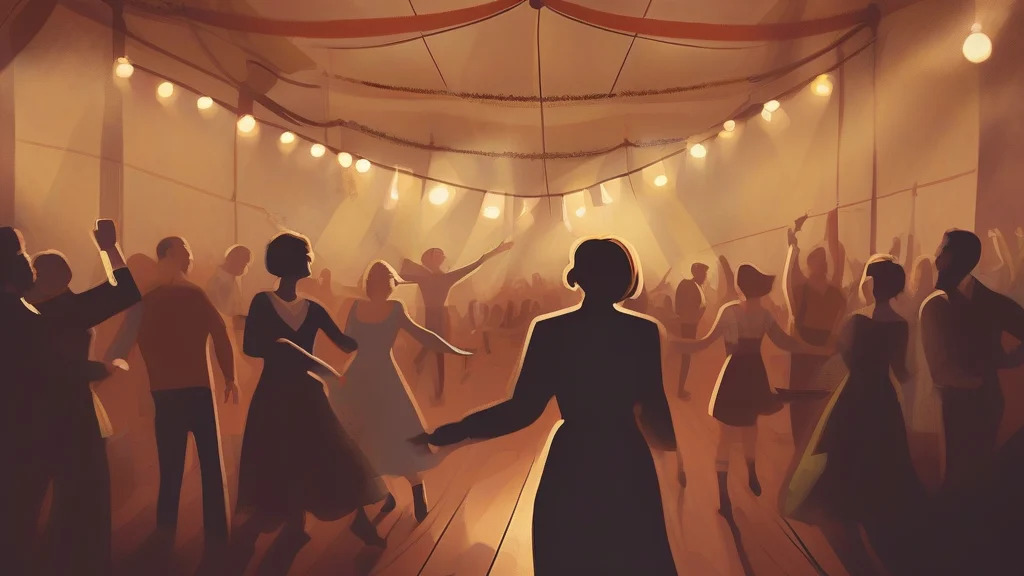
What does ceilidh mean?
A ceilidh is a traditional social gathering featuring Scottish or Irish folk music, dancing, and song, often held in village halls, at weddings, or during festivals. The word comes from the Gaelic term for a visit or gathering, originally denoting an informal evening spent telling stories and singing songs in a neighbour's home before it evolved into its modern sense of a public dance event. At a typical ceilidh today, a live band plays jigs and reels while a caller guides dancers through simple set dances such as the Gay Gordons or Strip the Willow, making the occasion accessible even to complete beginners. The word carries warm connotations of community, hospitality, and shared cultural heritage, and it remains a vibrant fixture of social life across Scotland, Ireland, and diaspora communities worldwide. Its distinctive spelling and pronunciation make it instantly recognisable as a marker of Celtic tradition.
nounA social gathering with traditional music, dancing, singing, and storytelling, associated especially with Scottish and Irish culture.
- A traditional Scottish or Irish social event featuring folk music, dancing, and often storytelling or song.
- (Historically, in Gaelic-speaking communities) An informal evening visit or gathering at which stories were told and songs sung.
"The village hall hosted a lively ceilidh to raise funds for the church roof."
"Guests at the wedding were treated to a ceilidh complete with a live fiddle band."
"In the old days, neighbours would gather for a ceilidh, swapping tales by the fire long into the night."
Regular English plural, formed simply by adding -s despite the Gaelic spelling.
"The society organises ceilidhs throughout the winter months."
A ceilidh isn't just a party — it's centuries of Gaelic storytelling and fiddle music packed into one night of dancing.
Reviewed by Deb Chak, Editor. AI-assisted content curated by RJS Tech Solutions LLP.
Etymology of ceilidh
Ceilidh derives from the Irish 'céilí' and Scottish Gaelic 'ceilidh', both meaning 'visit' or 'gathering', ultimately from Old Irish 'céile' meaning 'companion' or 'fellow'. The word entered English in the 19th century as interest in Gaelic culture grew. It reflects the longstanding Gaelic tradition of communal evenings devoted to storytelling, music, and song, later shifting to denote organised social dances.
How ceilidh is actually used
The word is strongly associated with Scottish and Irish cultural events and is common in British English, especially in Scotland and Northern Ireland. Plural is 'ceilidhs'. The anglicised pronunciation /ˈkeɪli/ is standard in English; the Gaelic pronunciation differs. It carries warm, convivial connotations of community celebration.
Easily confused with ceilidh
Despite a superficial visual similarity in spelling, a ceilidh is a social gathering with music and dancing, whereas a kaleidoscope is an optical toy producing shifting patterns.