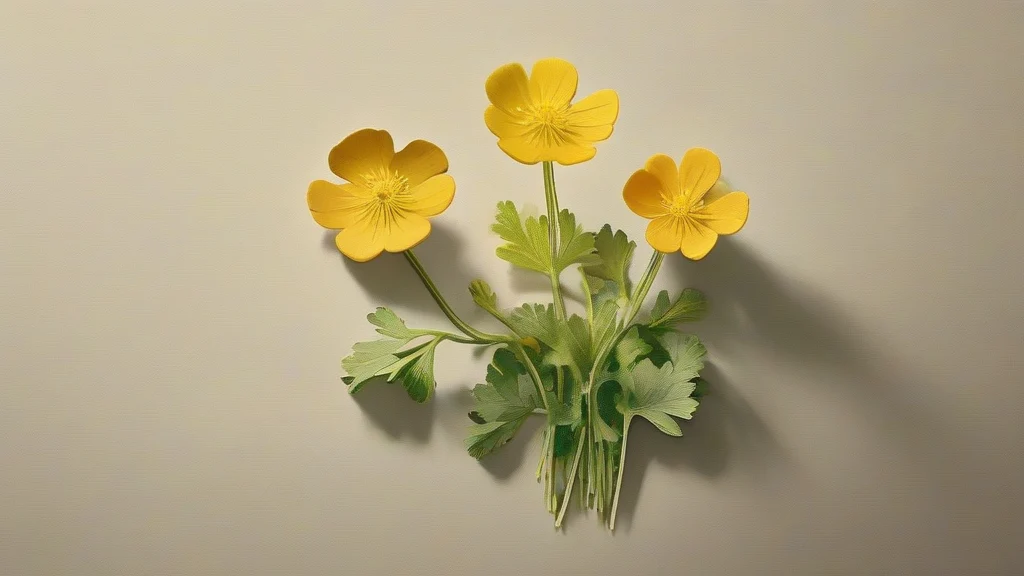
What does celandine mean?
Celandine is the common name shared by two quite different yellow-flowered plants of the European countryside. The greater celandine, Chelidonium majus, is a member of the poppy family, growing to about a metre tall with four-petalled yellow flowers and a conspicuous orange latex that has long been used, cautiously, as a folk remedy for warts and other skin conditions. The lesser celandine, Ficaria verna, belongs instead to the buttercup family: a low, ground-hugging perennial whose glossy golden stars open on sunny days from late winter onward, often blanketing damp woodland floors and hedgebanks. Because the two share nothing beyond their name, gardeners and botanists nearly always qualify which plant they mean. Both names derive ultimately from the Greek word for swallow, reflecting the old belief that the flowers timed themselves to the bird's migration — appearing when the swallows returned. Celandine appears most often in nature writing, field guides, and poetry, where it carries gentle connotations of early spring, rural lanes, and quiet renewal.
nounEither of two yellow-flowered plants: the greater celandine (Chelidonium majus), a poppy-family herb with orange sap, or the lesser celandine (Ficaria verna), a small spring-flowering buttercup relative.
- Greater celandine, Chelidonium majus, a perennial herb of the poppy family with yellow flowers and bright orange latex sap, formerly used in herbal medicine for skin complaints.
- Lesser celandine, Ficaria verna (formerly Ranunculus ficaria), a low-growing spring wildflower of the buttercup family with heart-shaped leaves and glossy yellow flowers.
"Lesser celandine carpeted the woodland floor with glossy yellow blooms well before the bluebells appeared."
"The herbalist crushed a celandine leaf to show us its vivid orange sap."
"Wood anemones and celandine starred the hedgerow banks in early April."
Regular English plural; used when referring to multiple plants or patches of either species.
"The south-facing bank was already starred with celandines by mid-March."
The name 'celandine' literally means 'swallow flower' — it comes from the ancient belief that the plant bloomed when swallows arrived and withered when they left.
Reviewed by Deb Chak, Editor. AI-assisted content curated by RJS Tech Solutions LLP.
Etymology of celandine
The word celandine entered English via Old French celidoine from Latin chelidonia, itself derived from Greek chelidōnion, a diminutive of chelidōn meaning 'swallow'. Ancient writers such as Pliny recorded the belief that the plant bloomed when the swallows returned and faded when they departed, hence the name. The same Greek root gives the modern genus name Chelidonium for the greater celandine.
How celandine is actually used
Because the name covers two botanically unrelated plants, careful writers usually specify 'greater celandine' or 'lesser celandine'. The word is chiefly found in botanical, gardening, and literary contexts; in Britain the lesser celandine is celebrated as one of the earliest spring flowers, famously praised by Wordsworth. Note that what North American gardeners sometimes call 'celandine poppy' (Stylophorum diphyllum) is a related but distinct plant.
Easily confused with celandine
Though both are wildflowers, chicory is a tall blue-flowered composite plant, whereas celandines bear yellow flowers and belong to entirely different families.