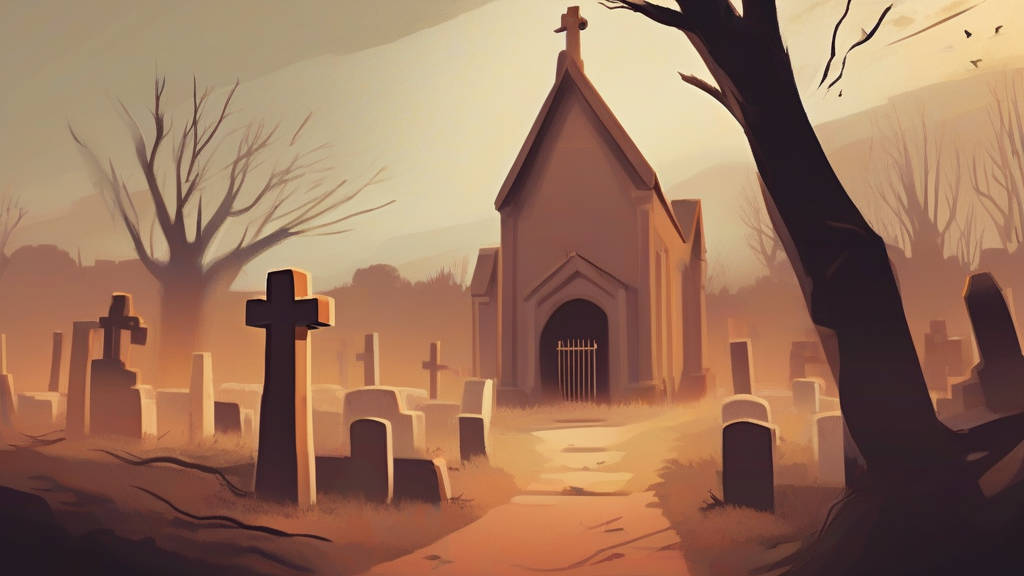
What does cemetery mean?
A cemetery is an area of ground reserved for the burial of the dead, typically organized into graves, plots, and pathways and marked by headstones, monuments, or other memorials. Unlike a graveyard, which historically lies adjacent to a church, a cemetery is generally an independent, often municipally or privately managed site, and it may serve any community regardless of religious affiliation. The word functions as a straightforward noun in both formal and informal contexts, appearing in phrases such as military cemetery, municipal cemetery, and cemetery plot. Its connotations are solemn but respectful rather than grim, and it is the standard, neutral term in news reporting, legal documents, and everyday speech. Etymologically, cemetery traces back through Late Latin to the Greek word for a sleeping place, reflecting an ancient tradition of describing death as sleep. From vast national cemeteries to small rural burial grounds, the word covers a wide range of places united by a single purpose: providing a dignified resting place for those who have died.
nounAn area of ground set aside for the burial of the dead, typically one that is large, formally laid out, and not attached to a church.
- A tract of ground used as a burial place for the dead, usually laid out with graves, paths, and memorials and not attached to a church.
"They walked quietly through the old cemetery, reading the weathered inscriptions on the headstones."
"Arlington National Cemetery is the resting place of thousands of American service members."
"The city's oldest cemetery was designated a historic landmark last year."
The standard plural follows the regular -y to -ies pattern for nouns ending in a consonant plus y.
"The region is dotted with centuries-old cemeteries, some still in active use."
"Cemetery" literally means "sleeping place" in ancient Greek — a word so gentle it turned death into rest.
Reviewed by Deb Chak, Editor. AI-assisted content curated by RJS Tech Solutions LLP.
Etymology of cemetery
Cemetery entered English in the late Middle Ages, borrowed via ecclesiastical Latin and Old French, and derives ultimately from the Greek koimētērion, meaning a sleeping place, formed on the verb koiman, 'to put to sleep.' The underlying image treats death as sleep, which explains the word's originally euphemistic character. Early English use applied it chiefly to underground Christian burial chambers, known as catacombs, before it broadened to mean any burial ground.
How cemetery is actually used
Neutral in register and appropriate in formal writing, journalism, and everyday speech alike. It carries no euphemistic or negative connotation, though speakers often soften it conversationally with phrases such as 'laid to rest.' In British usage, 'churchyard' may be preferred when referring to a church's own burial ground.
Easily confused with cemetery
A graveyard traditionally sits on land adjoining a church, while a cemetery is a standalone burial ground, often larger and secular.
Symmetry means balanced correspondence of parts on either side of an axis, while a cemetery is a burial ground — they differ entirely in meaning despite a superficial resemblance.