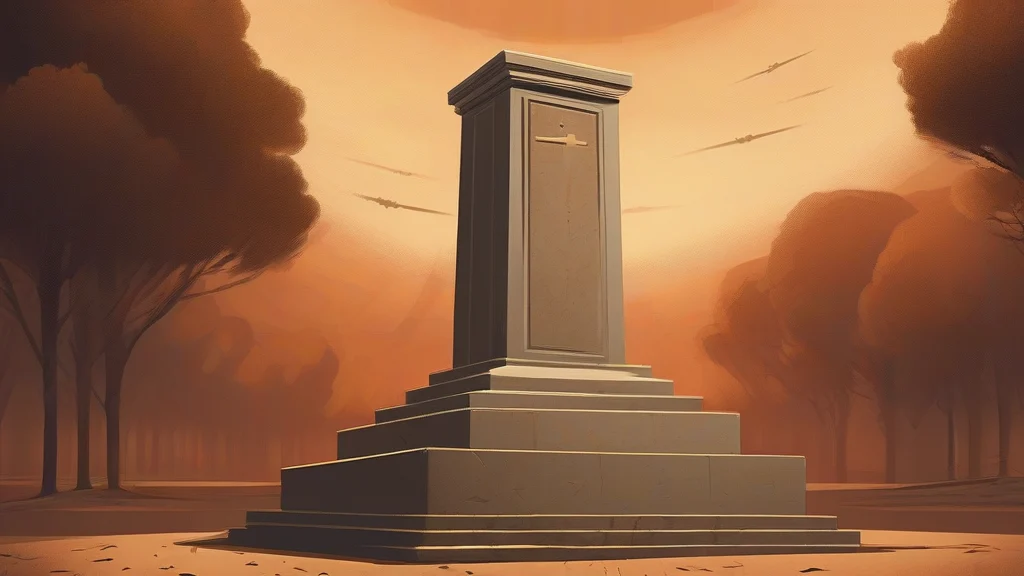
What does cenotaph mean?
A cenotaph is a monument built to honour a person or group of people who are buried somewhere else, or whose bodies were never recovered. Unlike a tomb or grave marker, it holds no remains — the name comes from Greek words meaning 'empty tomb'. Cenotaphs are most often associated with soldiers lost in war, particularly those who died overseas or went missing in action, giving families and communities a focal point for mourning and remembrance. The best-known example is the Cenotaph in Whitehall, London, designed by Sir Edwin Lutyens and unveiled in 1920, which serves as the centrepiece of Britain's annual Remembrance Sunday ceremonies. Many towns and villages across Britain and the Commonwealth have their own local war cenotaphs. The word carries a formal, solemn tone and appears mainly in contexts of commemoration, history, and public memorial. Knowing the term helps distinguish these intentionally empty monuments from graves, tombs, and general memorials.
nounA monument erected in honor of a person or group of people whose remains are buried elsewhere, or whose remains were never recovered.
- A monument honouring a person or people whose remains lie elsewhere or were never found.
"The village raised a cenotaph to honour the soldiers who fell in the war and were buried overseas."
"Wreaths were laid at the Cenotaph during the Remembrance Sunday service."
"After the ship was lost with all hands, the town built a cenotaph because there were no bodies to bury."
Standard regular plural; used when referring to multiple such monuments, as in towns across a region.
"War cenotaphs stand in market squares throughout the country."
London's most famous war memorial — the Cenotaph — is literally an 'empty tomb': no one is buried there, and that's exactly the point.
Reviewed by Deb Chak, Editor. AI-assisted content curated by RJS Tech Solutions LLP.
Etymology of cenotaph
Cenotaph comes from Greek kenotaphion, formed from kenos meaning 'empty' and taphos meaning 'tomb' — literally an empty tomb. The word entered English in the early 17th century, borrowed via Latin cenotaphium or directly from Greek. It shares its root element taphos- with related terms such as epitaph (a writing upon a tomb) and the scientific term taphonomy (the study of how organisms decay and become fossilized).
How cenotaph is actually used
The word carries a solemn, formal register and is strongly associated with commemoration of war dead, especially in Britain and Commonwealth countries. When capitalized ('the Cenotaph'), it typically refers to Sir Edwin Lutyens' 1920 memorial in Whitehall, London. The word derives from Greek kenos ('empty') and taphos ('tomb') — literally an empty tomb.
Easily confused with cenotaph
A monument is any structure commemorating a person or event, whereas a cenotaph specifically honours someone buried elsewhere or with no known grave.
A tomb contains remains, while a cenotaph is deliberately empty — it commemorates the dead without holding their body.