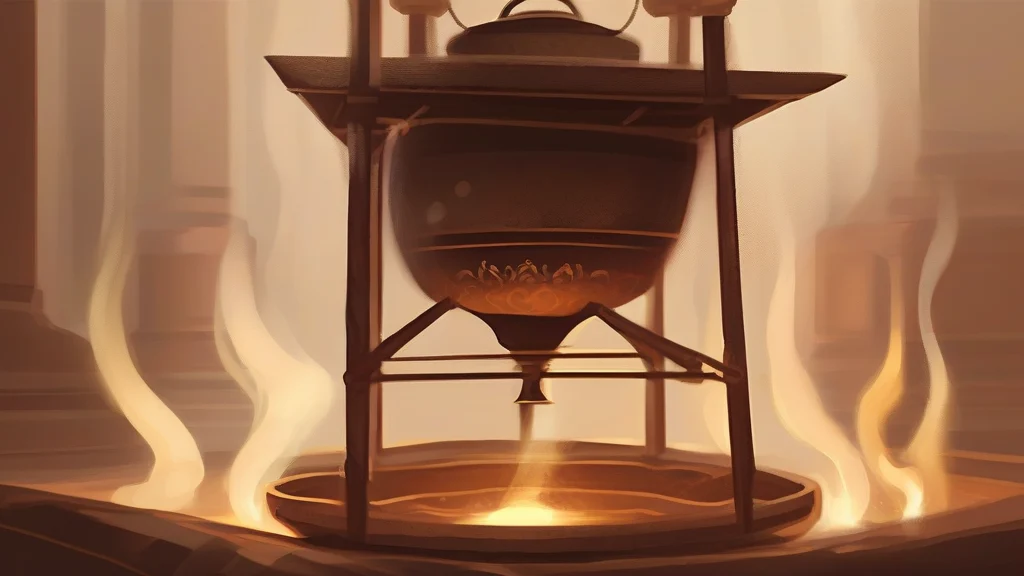
What does censer mean?
A censer is a container — usually of metal such as brass, bronze, or silver — in which incense is burned, most commonly during religious services. In many Christian traditions, including Roman Catholic, Eastern Orthodox, and Anglican worship, the censer takes the form of a perforated cup suspended from chains so it can be swung by a priest or server, dispersing sweet-smelling smoke through the church as a sign of prayer rising to heaven; this liturgical form is also called a thurible. The word appears almost exclusively in religious or historical contexts, describing everything from grand processional censers in cathedrals to small household burners used in ancient rituals. Its close association with ceremony gives the word an elevated, slightly archaic flavor, making it a precise and evocative choice when writing about worship, temples, or sacred tradition.
nounA container, typically made of metal and often suspended on chains or swung, in which incense is burned, especially during religious ceremonies.
- A vessel, usually metal and often hung on chains, in which incense is burned during religious ceremonies.
- Any container used for burning incense, whether ceremonial or domestic.
"The priest swung the censer, sending fragrant smoke drifting through the cathedral."
"The acolyte handed the bishop the silver censer before the procession began."
"In the dim light of the temple, a bronze censer smoldered on the altar, filling the air with sandalwood smoke."
Standard regular plural; used when referring to multiple vessels, as in museum collections of ancient censers.
"The exhibition displayed bronze censers unearthed from Byzantine churches."
The swinging chain censer you see at a Catholic high mass has a proper Latin name — the thurible — and its smoke has been perfuming worship for well over a thousand years.
Reviewed by Deb Chak, Editor. AI-assisted content curated by RJS Tech Solutions LLP.
Etymology of censer
Censer entered English in the late Middle Ages via Old French, ultimately deriving from the Latin verb incandescere's relative incensus, the past participle of incendere, meaning 'to set alight' — the same root that gives us 'incense'. The underlying stem traces further back to the Latin candere, 'to glow or shine', which also produced words like 'candle', 'candid', and 'incandescent'. A censer is thus literally a thing in which something is kindled and made to glow.
How censer is actually used
Censer is a relatively formal word belonging chiefly to religious and liturgical contexts; it appears rarely in everyday conversation but is standard in writing about church ritual, especially Catholic, Orthodox, and Anglican traditions.
Easily confused with censer
A censor is a person who suppresses or examines content, while a censer is a vessel for burning incense.
Censure means to criticize harshly, whereas a censer is a metal container for burning incense.